Autoimmunity: From Immune Misfires to Targeted Therapies
Research into immune tolerance helps reveal how autoreactive cells arise and how targeted immunotherapy and cell therapy development might better treat autoimmune diseases.
A network of developmental and peripheral safeguards typically prevents the immune system from destructive self-reactivity. But when those safeguards fail, autoreactive immune cells can expand, produce autoantibodies, and activate inflammatory pathways that contribute to autoimmune disease development. Research into these mechanisms informs therapeutic design to suppress inflammation and restore immune tolerance. In this article, learn about different types of autoimmune diseases and how scientists develop treatments that address autoimmunity.
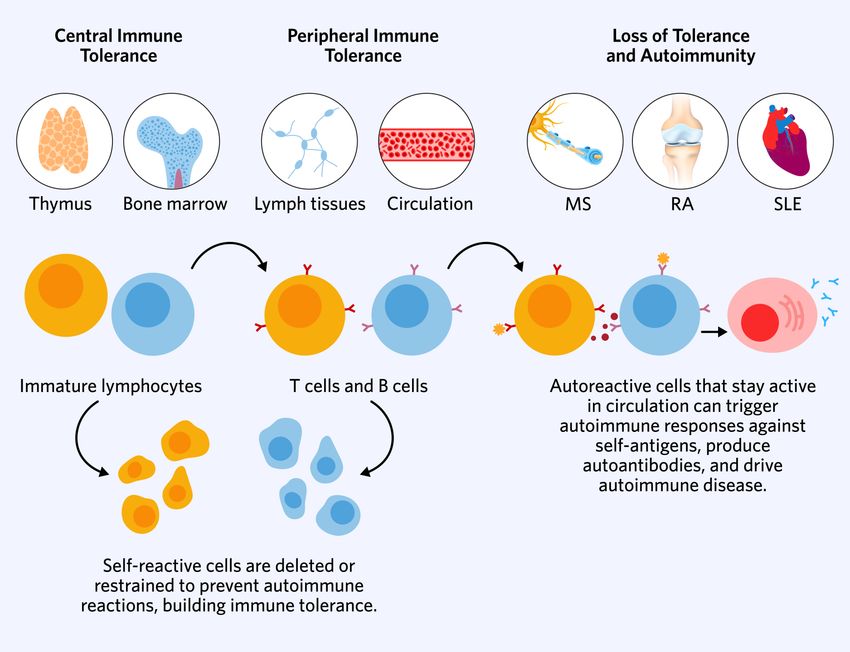
In autoimmunity, autoreactive immune cells produce self-reactive antibodies and trigger inflammatory pathways that contribute to disease development.
Autoimmunity is the recognition of self-antigens by adaptive immune system components. Autoimmune disease is the resulting pathological state in which this immune activity contributes to tissue damage or impaired organ function.1
During immune system development, immature T cells in the thymus and B cells in the bone marrow undergo selection processes that eliminate or restrain cells that are strongly reactive to self-produced molecules, building immune tolerance. Peripheral mechanisms such as autoreactive immune cell deletion and suppression by regulatory T cells (Tregs) provide additional layers of protection.1,2
Factors such as genetic variations and environmental exposures that activate the immune system can influence how effectively these safeguards operate. Mutations in immune-regulatory genes or major histocompatibility complex variation, for example, can alter T lymphocyte activation thresholds, while infections and other environmental signals may provide inflammatory cues that awaken otherwise quiescent autoreactive immune cells.3
Antibodies are proteins produced by B cells and plasma cells that normally recognize foreign molecules, helping the immune system identify and eliminate pathogens. In autoimmunity, B cells may generate antibodies that target self-antigens. These self-reactive antibodies are known as autoantibodies. After binding to self-targets, autoantibodies form immune complexes or interfere with cellular signaling. These autoantibodies can serve as biomarkers for developing disease diagnostics. They may also precede disease manifestations, helping scientists study the evolution of autoimmune responses.4
Autoreactive cells that evade immune tolerance mechanisms can trigger autoimmune responses and drive autoimmune disease.
Autoimmune Diseases and Implicated Immune Pathways
Autoimmune diseases encompass a diverse group of disorders with different molecular drivers.1 Examples of commonly studied autoimmune diseases include the following.
Rheumatoid arthritis is a chronic autoimmune condition characterized by joint inflammation, with autoantibodies such as rheumatoid factor and anti-citrullinated protein among the most well-studied pathogenic molecules.5
Systemic lupus erythematosus (SLE) is driven by autoreactive B cells and T cells, type I interferons, immune complexes, and defective clearance of cellular debris that, together, produce inflammation across multiple tissues.6,7
Inflammatory bowel disease, encompassing Crohn’s disease and ulcerative colitis, is caused by immune-mediated inflammation in the intestinal tract. It involves a variety of interactions between intestinal microbes, epithelial cells, and innate and adaptive immune pathways.8
Multiple sclerosis (MS) pathogenesis involves autoreactive T cells, B cells, and innate immune cells that contribute to inflammation and demyelination in the central nervous system. However, research increasingly suggests that MS is more complex than a T cell-versus-myelin model, highlighting the importance of investigating neurodegenerative as well as autoimmune disease mechanisms.9,10
Autoimmune encephalitis encompasses a group of neurologic disorders associated with autoantibodies targeting neuronal or synaptic proteins such as the N-methyl-D-aspartate receptor and leucine-rich glioma-inactivated 1 protein, which can alter neuronal signaling.11,12
Autoimmune Disease Therapies
As researchers uncover the cellular mechanisms underlying autoimmunity, drug discovery and development strategies seek to selectively alter or reset dysfunctional immune responses rather than simply suppressing the entire immune system. Immunotherapies and adoptive cell therapies are two avenues that scientists investigate to achieve more targeted immune regulation.
Immunotherapy
Immunotherapies modify the activity of the immune system. For autoimmune disease applications, researchers are investigating immunotherapies that can selectively dampen harmful immune responses while preserving the immune system’s ability to protect against infection and other threats. These approaches aim to target specific cells, molecules, and signaling pathways that drive autoimmunity.
For instance, scientists are exploring whether increasing the number or activity of Tregs could restore the balance between inflammatory and regulatory immune cells in autoimmune disease.2 One strategy to modulate Treg behavior is low-dose interleukin-2, which can preferentially stimulate Tregs without activating effector T cells in patients with autoimmune and inflammatory diseases.13 Clinical studies examining this approach for treating conditions such as SLE and MS are ongoing.14,15
Adoptive cell therapy
Adoptive cell therapy (ACT) involves administering immune cells that have been selected or genetically engineered and expanded outside the body. ACTs are an evolving area of translational research for autoimmune diseases.
Treg-based ACTs may help clinicians introduce an immune cell population capable of suppressing autoreactive immune responses. Early clinical studies, for instance, demonstrated that patient-derived Tregs could be expanded and transferred back to the same patient safely, although subsequent studies have highlighted the difficulty of achieving durable efficacy with broadly reactive Tregs.16
Researchers are also investigating antigen-specific Tregs and T cell engineering for autoimmune ACT. Chimeric antigen receptors (CARs), initially developed to redirect T cells against cancer, may be adapted to recognize immune targets relevant to autoimmunity. For example, CAR-Treg approaches aim to combine the regulatory function of Tregs with more precise targeting. 17,18
Another example is CD19 CAR T cells, which were initially developed to treat certain types of leukemia and lymphoma through targeted immune clearance of B cells that express CD19. These engineered cells have been examined for their ability to deplete B cells in severe autoimmune disease cases, such as for SLE, idiopathic inflammatory myositis, and systemic sclerosis.19
Future Directions for Autoimmune Disease Research
The next generation of autoimmune research will likely focus on precision immunology, determining which immune pathways drive disease in particular patients and intervening with targeted therapeutics. Molecular profiling, single-cell technologies, and longitudinal analysis of autoantibodies may help researchers distinguish biologically different forms of the same disease.20 For cell therapies, the central challenge is specificity to avoid the unwanted consequences of broadly suppressing immune responses through entire B cell or T cell depletion.
The field is consequently moving toward a more ambitious definition of immunotherapy. Rather than suppressing an overactive immune system indefinitely, researchers are asking whether it can be retrained. If those efforts succeed, autoimmunity research could shift from controlling chronic inflammation toward restoring the mechanisms that teach the immune system what belongs to the body in the first place.
Deanna earned their PhD from McGill University in 2020, studying the cellular biology of aging and cancer. In addition to a passion for telomere research, Deanna has a multidisciplinary academic background in biochemistry and a professional background in medical writing, specializing in instructional design and gamification for scientific knowledge translation. They first joined The Scientist's Creative Services team part time as an intern and then full time as an assistant science editor. Deanna is currently an associate science editor, applying their science communication enthusiasm and SEO skillset across a range of written and multimedia pieces, including supervising content creation and editing of The Scientist's Brush Up Summaries.
Miles away from the closest ocean, marine microbes thrive in the red ice and mud around Blood Falls, offering clues to microbial adaptation and past climate events.
Explore how blood-based biomarkers perform across Alzheimer’s disease stages, including AIBL Study findings comparing p-Tau217 and other markers against amyloid-beta and tau PET reference standards.
Explore how super-resolution microscopy enables particle-level characterization of lipid nanoparticle composition, cargo loading, heterogeneity, and stability, providing complementary insights for formulation development and optimization.
The placements follow the commercial launch of Pyxa at the Advances in Genome Biology and Technology (AGBT) meeting in February 2026 and mark the company's transition from Early Access into global commercial availability.
The CellRaft AIR streamlines antibody discovery with imaging, functional screening, and gentle isolation of viable single B cells and hybridomas, helping verify monoclonality and identify high producing clones faster.
Load plasma directly into prefilled cartridges, no pretreatment, no ethanol. Under 30 minutes of instrument run time, up to 48 samples in parallel, with a high-throughput format also available.
Two Paige tools, powered by the Virchow pathology foundation model, are now available within a single image management workspace for oncology research.