Career Chat: A ‘Mathemafishan’ Uses Population Modeling to Prevent Overfishing
Alise Fox loved math as a kid but had no idea what kinds of jobs it would lead to. Now, she works at the intersection of mathematical modelling, marine ecology, and science communication.
Alise Fox describes herself as a ‘mathemafishan,’ but that’s not a term found with a quick Google search—she made it up. Fox’s early interest in using mathematics to understand the world has led her down some interesting roads (literally), and her undiagnosed Attention-Deficit/Hyperactivity Disorder (ADHD) meant she struggled with academia. Now, the Australian data scientist and science communicator has found her niche at the Queensland Government’s Department of Primary Industries, bringing together multidisciplinary datasets to ensure marine species can thrive.
As a ‘mathemafishan,’ Alise Fox uses population modelling to make recommendations that prevent overfishing.
Todd Fox
Finding a Path: Bike Wobbles and Squishy Roads
Fox knew that she loved math from a fairly young age, but she wasn’t sure what that meant for her future career. Close friends had clear career pathways, deciding they wanted to be veterinarians and dentists. “But if you want to do math, that's really weird and ambiguous, and what does it even look like, and what does that mean?” Fox said. “So I looked around, and the only person I knew who did math for a job was my math teacher, and so I was like, ‘Okay, that's math as a job’.”
After completing a dual degree in science and education at the University of the Sunshine Coast, Fox got her first job teaching in a high school. After two terms, she decided it wasn’t right for her and went back to university to do an Honours degree. “I wanted to keep learning math and keep exploring mathematical modeling, which is using math to explain things in the real world,” she explained.
Continue reading below...
Like this story? Sign up for FREENewsletter updates:
Latest science news storiesTopic-tailored resources and eventsCustomized newsletter content
In her research project, Fox used mathematical models to study the biomechanics of cycling. “We got biomechanical data—we had all the sticky dots all over people—and looked at it in three dimensions [to see] how they wobble,” she said. Using her coding skills, Fox created a program that could perform biomechanical analysis using math.
After completing an Honours degree studying bike wobbles and feeling comfortable in academia, Fox was ready for a PhD and started a project that aimed to use math to figure out why Australian roads are riddled with potholes. “Can we explain the patterns that we're seeing using equations, using lots of physics and math and whatever, and put it all together?” Fox explained. “And can we use that to understand how road degradation [works], how the road squishes, and how that changes with temperature or the speed at which people are driving and braking?”
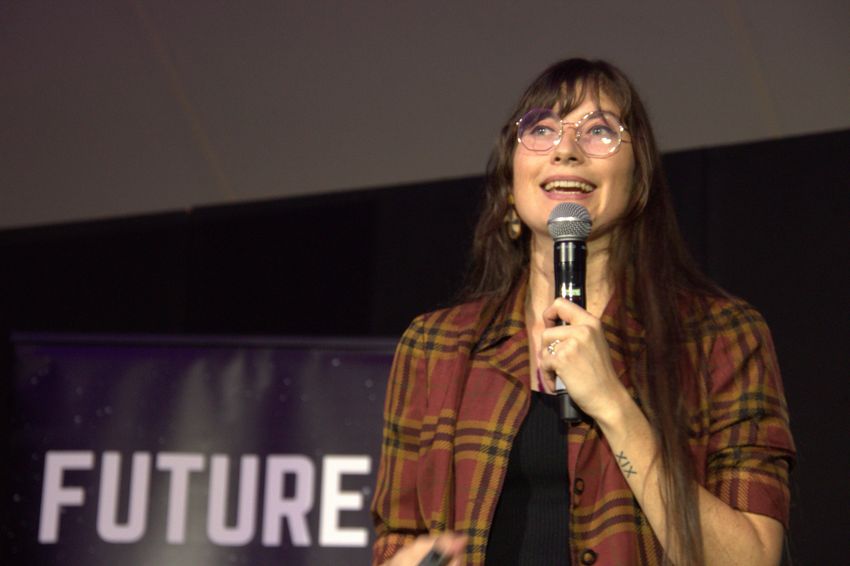
Outside her day job, Fox spends time talking to people about science and math, including young aspiring scientists.
Jiao Jiao Li
It didn’t end well, something she puts down to three key factors: a project she wasn’t passionate about, a difficult relationship with her supervisor, and undiagnosed ADHD. After some agonizing and at the suggestion of her supervisor, she downgraded her PhD to a master's degree. Convinced academia wasn’t for her, Fox decided it was time to get a real job.
Day in the Life of a Mathemafishan
A friend who was working as a scientist for the Queensland state government told Fox there was a math-related job opening and encouraged her to apply. “That was looking at fisheries, and I had no idea what a fishery even was,” Fox said. She hated it at first and felt intense imposter syndrome.
After a couple of weeks of wanting to quit, Fox went to her boss to ‘confess.’ “I [said], ‘This is impossible. This is not my world. I don't belong here,’” she recalled. Her boss’s supportive response was a shock. “She [said], ‘Of course, you don't know any of this stuff. You literally just got here, and we know what your CV is, and we didn't hire you for your fish knowledge. We hired you for all these other reasons. Just keep going with it.’ And I think that was really important, because [it was] step one to conquering imposter syndrome.”
Now, Fox loves her job as a senior fisheries scientist. The role of ‘mathemafishan,’ as she now calls it, involves using math to create population models of wild fish stocks. “It's a lot of math, obviously, and statistics and marine biology and ecology and programming and data science and a whole lot of other things in one,” she explained. “My job is to bring together all these different things and make them cohesive and use a lot of math and complicated stuff to tell a story with all of this data.”
The fish stock assessments Fox prepares with her team are used to make recommendations so that wild populations are not at risk of being overfished, ensuring the sustainability of commercial fisheries. “The result I get out is, basically, how many fish are left compared to some time in the past?” she said. “Depending on what that is, I can make recommendations to the fishery managers about what they should be catching next year or what things that you might want to change about how the fisheries are managed.”
The job isn’t always easy; telling the people whose livelihoods depend on catching fish that they can’t catch as many often does not go down well. To combat the friction between stakeholders, Fox has championed the idea of using science communication tools to make all parties feel involved and ensure they understand why the recommendations are necessary.
Fox’s watercolor paintings of marine species often go on the covers of her fisheries stock assessments, and help her explain the wonders of marine life to non-scientists.
Todd Fox
“[It’s about] making sure that the people out there catching the fish [aren’t] impacting the population, but they can also keep working, and there are jobs, and there's food security,” she remarked. “It's talking to those people and making sure that we're all on board and letting them know that we're all on the same team and have the same goals.”
Outside of her day-to-day, Fox spends lots of time on science communication, encouraging a love for marine ecosystems and the natural world, speaking openly about her struggles with ADHD and feeling like she didn’t fit within academia, and advocating for women in STEM. She’s even done a TEDx talk about how hobbies can be important for career growth, painted watercolors of marine species for her industry reports and science communication videos, and performed at the juncture of science and comedy. She plans to complete an industry PhD within her current role.
Fox’s long-term goal is to become Queensland’s Chief Scientist. In the meantime, she spends as much time as possible talking to people about science and math and explaining what she does as a mathemafishan. “Because when I was younger, I didn't [know about] anything like this, and I would have loved it,” she said. “So, a lot of what I do is [to] ‘Do it for little Alise!’”
Add The Scientist as a preferred Google source to see more of our trusted coverage.
Rebecca Roberts is a science writer and communicator. She earned her PhD in molecular biology from the University of the Sunshine Coast in Australia and completed a two-year postdoctoral fellowship at Lund University in Sweden. Her writing focuses on gene editing technology, cell and gene therapies, and the regulatory space.
Miles away from the closest ocean, marine microbes thrive in the red ice and mud around Blood Falls, offering clues to microbial adaptation and past climate events.
Explore how super-resolution microscopy enables particle-level characterization of lipid nanoparticle composition, cargo loading, heterogeneity, and stability, providing complementary insights for formulation development and optimization.
The CellRaft AIR streamlines antibody discovery with imaging, functional screening, and gentle isolation of viable single B cells and hybridomas, helping verify monoclonality and identify high producing clones faster.
Load plasma directly into prefilled cartridges, no pretreatment, no ethanol. Under 30 minutes of instrument run time, up to 48 samples in parallel, with a high-throughput format also available.
Two Paige tools, powered by the Virchow pathology foundation model, are now available within a single image management workspace for oncology research.