In the cold, chilly afternoons at the University of Guelph, evolutionary biologist Paul Hebert orchestrates more than 150 people with one mission: to name every living species that has ever existed on Earth. Enthusiasm greets the doorstep daily, as packages arrive from collaborators around the world—vials holding samples of species from every possible corner of the planet. A tiny sliver of tissue taken from these samples contains all the DNA needed to identify the species. As the team decodes and assigns names to these fragments, each passing day brings them closer to their unified mission of understanding the natural world.
While the project has a noble goal, for Hebert, this mission was born out of one emotion: frustration. As a lifelong naturalist overwhelmed by the thousands of species he couldn't tell apart, he once gave up biodiversity research altogether. That was until a supermarket barcode scanner sparked an idea for a new technology: DNA barcoding. Now at 79, Hebert still has his sights set on identifying all multicellular life on Earth.
A Backyard of Biodiversity Discoveries
Growing up in Kingston, next to Lake Ontario, Hebert was surrounded by biodiversity. “I think someone was salting my backyard with biological discoveries,” he said. In the summer, when he was six, he found a pair of the largest moths in North America, about six inches in length, sitting on a daylily plant. “I was staggered that these things could be so beautiful,” Hebert said. “I think this event might have set me off on this course because my childhood fascination became to study moths and butterflies.”

As a child, Paul Hebert explored the biodiversity of insects in his backyard, even finding a pair of the largest moths in North America.
Sylvie Li
Planning to study insects his whole life, Hebert set off to become a scientist. The path, however, was not an easy one. Despite his strong academic record, he didn’t win the Ontario scholarship that would have helped him cover his tuition at any university of his liking. Instead, he enrolled at Queen’s University in his city, where the professors he had worked with throughout high school when he was collecting and studying insects recognized his potential. They supported Hebert throughout his undergraduate years.
From there, it was an uphill climb. Hebert won the Commonwealth Scholarship, studied at Cambridge University, and turned to the molecular biology of evolution, focusing on water fleas, tiny freshwater crustaceans. His postdoctoral expeditions took him to places like Papua New Guinea and the Canadian Arctic. But despite these daring adventures, Hebert was not satisfied. While his lifelong passion was telling species apart just by looking at them, the traditional academic pathway had Hebert narrow his focus into a single genus of water fleas.
He returned to Canada in 1976, accepting a position at the University of Windsor, where he served as a professor of Biological Sciences. During his two-week field expeditions, which he preferred over lecturing, students would collect different species of insects and would ask Hebert if he could tell them apart. To his surprise, he couldn’t.
This made him restless.
“So here is a frustrated academic, someone who loves biodiversity, getting into his mid-fifties, realizing he can’t tell species apart,” he said. “I realized I was wasting my life.”
A Grocery Store Scanner and DNA Barcoding
Despite having identified 2 million species, humanity still cannot quantify the total number of species that exist or have ever existed on Earth.1
This question kept Hebert up at night, quite literally, until one day he found an answer while shopping at his local grocery store. “Looking at the barcodes, I thought, ‘My God, these little strings can tell apart everything in this store! Why can’t I tell apart every species on the planet by just reading a little string of nucleotides?’”
After the invention of the polymerase chain reaction, Hebert could recover specific bits of DNA from any organism. He focused on the third position in DNA codons—a site prone to change due to the redundancy of the genetic code, where mutations often don’t alter the resulting protein. To identify these changes, he would need to focus on a gene that was both common enough that most animals had it and one that mutates faster than most genes so that its sequence would differ even among closely related species. He settled on a segment of a gene called cytochrome c oxidase I (COI), which sits in the mitochondria. Then, he set out into his garden to test the idea.
Back in 1978, Hebert had given away his entire insect collection, convinced he could never identify enough species to make sense of them. But then, more than two decades later, he went back to his favorite organisms: insects. Hebert hung a light in his backyard and collected moths for the first time in years. He pulled a single leg from each and used it to sequence the COI gene.

DNA barcoding has helped scientists identify new species across the globe.
©iStock.com, jxfzsy
"Every one of those species had a distinct barcode," he said. This invention, which would later be named DNA barcoding, revolutionized the study of biodiversity and earned Hebert the title of the “father of DNA barcoding.”
But in 2002, long before that title, his first paper on the idea was rejected, though the journal invited him to resubmit it. He would have traded everything for that publication. "Ablate all my work," he recalled thinking. "Leave me with this one paper because I think it might change things." With some revisions, he published his paper in early 2003.2
The initial reception, however, was rough. The Sloan Foundation sponsored two meetings on DNA barcoding at Cold Spring Harbor, and the first, held that March, turned into what Hebert calls "a rooster fight.” Some of the skepticism came from scientists who worked on single organisms and had never faced the problem that barcoding was built to solve. "There were the armchair people that only study fruit flies in jars," Hebert said. "They didn't really understand why you need to do this."
There was a deeper resistance too, one that had less to do with science than with how science had always worked. For generations, identifying a species depended on a taxonomist's personal expertise, often built over a career spent studying one particular group of organisms. Barcoding proposed replacing that individual skill with a single, standardized test anyone could run. "Humans hate standardization," Hebert said. "Humans love individuality, especially scientists."
There were a lot of critics in places that Hebert hadn’t expected, but there were some strong supporters as well. Among the attendees was Daniel Janzen, an evolutionary ecologist at the University of Pennsylvania, who had spent his life studying biodiversity and concluded that morphology alone could never catalogue it.
“His talk to us in Cold Spring Harbor changed our science and personal trajectory enormously,” Janzen said. “His incredible administrative drive and wide biodiversity scope and curiosity have been now as still intense as they were in 2003, and now DNA barcoding is known and used the world over.” Janzen forged a deep connection with Hebert’s work. At 87, he still writes to Hebert regularly.
Plans to Map Every Species on Earth
In the decade that followed the Cold Spring Harbor meetings, researchers across the globe started using DNA barcoding in a variety of ways, including to differentiate one species from another, to identify larval or juvenile stages of the same species, and to describe new species. Soon, barcoding became the way to catalogue life and find the ‘fingerprint’ of any organism. Scientists could generate DNA barcodes for all forms of life and build DNA barcode reference databases.
To learn more about this technique, talented graduate students and undergraduates began to flock to Hebert’s lab to work with him. One of them was Melania Elena Cristescu, who trained under Hebert to obtain a PhD in evolutionary biology in 2004.
“While I was interviewing with people, with potential supervisors, he was most definitely the most open-minded and dynamic person,” Cristescu said. “When you get to work with him, what is incredibly obvious is how efficient he is,” she said. If she raised a question in a meeting—even something like a potential postdoctoral position connection—Hebert would pull the name or make a phone call and solve the problem on the spot. Manuscripts worked the same way: She'd hand him a draft, and it would be back on her desk the next day, already marked up.

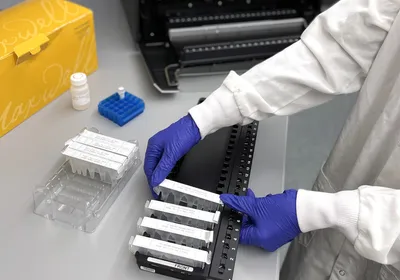
The team at the Center for Biodiversity Genomics at the University of Guelph uses DNA barcoding to identify species and protect biodiversity.
Suz Bateson (Centre for Biodiversity Genomics)
That mentorship never really faded. Cristescu went on to build her own faculty career, and decades later, she and Hebert still collaborate on grants and papers. “He maintains a connection with his students who stay in academia,” she said.
At 79, Hebert now directs the International Barcode of Life Consortium and is the chief executive officer of the Center for Biodiversity Genomics at the University of Guelph, which he helped build. Hebert has raised millions of dollars for his project to name and identify every living species that has lived on the planet, and he has no plans of stopping. Looking ahead, Hebert’s stubborn optimism remains undimmed. He dreams of raising $1 billion to finish the inventory of life within the next twenty years. “When I’m 97, we’ll have completed and registered every multicellular species on Earth,” he said.
Despite all of his contributions to researchers’ understanding of biodiversity, Hebert is humble.
“Science is this immense edifice, and you get to decorate one room in it,” he said. “I view my contributions as pretty trivial and insignificant, but they have set in motion a really interesting enterprise—one which will change biology because of this collective effort.”
- Costello MJ, et al. Can we name Earth’s species before they go extinct? Science. 2013;339(6118):413-416.
- Hebert PDN, et al. Biological identifications through DNA barcodes. Proc R Soc B. 2003;270(1512):313-321.