It was the afternoon of April 24, 2018, when Sacramento police made the monumental arrest of 72-year-old Joseph DeAngelo, widely known as the Golden State Killer. DeAngelo was a notorious burglar, rapist, and serial murderer who had eluded them for decades.
It was massively parallel sequencing (MPS), otherwise known as next-generation sequencing, that enabled detectives to identify DeAngelo based on a DNA profile match on a public ancestry database and arrest him for his prolific crimes. Since then, the application of massively parallel sequencing in forensic investigative genetic genealogy (FIGG) has allowed detectives and forensic biologists to pursue many cases that would otherwise have gone cold using traditional technologies. Kirsty Wright, a forensic biologist who is currently working to overhaul a government-run forensic laboratory in Queensland, Australia, said this technology is impressive both in its sensitivity and the amount of information it can provide. “Massively parallel sequencing is a game changer,” Wright said.
Massively Parallel Sequencing Provides Answers Where STR Profiling Fails
Celso Teixeira Mendes Junior, a geneticist at the Forensic and Genomics Research Laboratory at the University of São Paulo, often collaborates with federal police to assist in investigations where currently used different DNA sequencing methods fall short. “Massively parallel sequencing is very important in two different aspects,” he explained. “First of all, research focusing on [providing] forensic solutions, I think, is of paramount importance.” This aspect of Mendes Junior’s research can involve working with different kinds of biological materials, like RNA, or exploring how epigenetics data might be applied in forensics to offer a different perspective in complicated cases. “The very important second aspect of this is the forensic casework itself.”

Geneticist Celso Teixeira Mendes Junior uses MPS to perform forensic research and assist detectives with casework. Here, Mendes Junior (left) and two of his students at the University of São Paulo have just sequenced a long-read genome in the lab.
Forensic and Genomics Research Laboratory, University of São Paulo
Currently, the gold standard method for creating a forensic DNA profile from a crime scene sample—often blood, hair, saliva, or semen—involves DNA extraction and quantification, PCR amplification of 21 short tandem repeat (STR) markers, and capillary electrophoresis. The resulting profile or ‘genetic fingerprint’ is compared to a sample from a suspect to produce a likelihood ratio. This is the ratio of the probability that the suspect's DNA is in the sample over the probability that it is not.
Forensic scientists begin a massively parallel sequencing workflow with similar extraction and quantification steps, followed by optional amplification depending on how much DNA is present, and target capture methods to remove non-human (microbial) DNA. After library preparation and barcoding, they will introduce the sample into a flow cell and then place it into the DNA sequencing platform. “After you get the results—perhaps two or three days later—you have to do a very important bioinformatics analysis on those samples,” remarked Mendes Junior.
The power of massively parallel sequencing is partly in the volume of data it can provide: While STR profiling analyzes 21 loci, massively parallel sequencing allows forensic biologists to scrutinize many thousands of DNA markers, such as single-nucleotide polymorphisms (SNPs), or, in some cases, entire genomes. “For example, to differentiate two individuals who are twins, how can you do that?” Mendes Junior said. “In my opinion, only massively parallel sequencing is a good approach, because you will find something like 40 or 50 variation sites differing between the two siblings [across the entire genome].”
Massively parallel sequencing will not make traditional methods like STR profiling redundant, but rather, it can be used as a complementary technology to interrogate samples when those methods fail to generate a DNA profile. “We're using samples that have already gone through STR testing and had no hit in our database, and then there's DNA remaining [in the sample],” said Teresa Vreeland, vice president of forensic genealogy services at Bode Technology, a forensic DNA analysis provider based in the United States. “From there, we use MPS to generate a high-density profile.”
Mendes Junior said that massively parallel sequencing can also be used to generate profiles from crime scene samples with very low quantities of DNA, or those that are old or degraded. “[Some sequencing platforms] are already dealing with 25 to 50 picograms of DNA.” Wright agreed, adding that the technology is becoming increasingly sensitive. “You only need a handful of cells to get a profile.”
Using Massively Parallel Sequencing to Solve Decades-Old Crimes and Resolve Mixed Profiles
To find possible offenders in cases where there are no clear suspects, massively parallel sequencing profiles are used for FIGG, whereby forensic analysts submit the profiles to public genealogy databases like GEDmatch or FamilyTreeDNA and look for relatives who match. In the case of the Golden State Killer, the profile submitted to the database yielded several matches that were the equivalent of third cousins; genealogy records and the age and locations of the crimes provided the rest, allowing detectives to identify DeAngelo.
In Australia, FIGG has yielded similar breakthroughs in long-unsolved cases. After a 2022 review that assessed the suitability of emerging forensic technologies to pursue historic sexual assaults, a team led by New South Wales Police Force (NSWPF) forensic scientist Alison Sears used massively parallel sequencing to determine that three separate assaults—in 1991, 1996, and 2002—had likely been committed by the same unknown male. In February 2026, a NSWPF strike force arrested a 77-year-old man who had been identified through a match with a close relative in genealogy databases, charging him with multiple historic offences. Sex Crimes Squad Commander, Detective Superintendent Jayne Doherty noted that, advanced DNA sequencing technology played a crucial role in the investigation and eventual arrest.

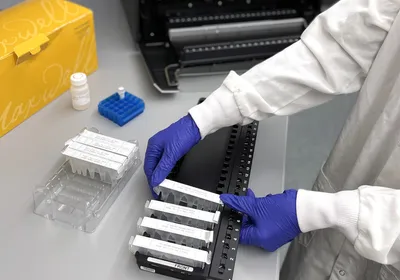
Bode Technologies is often hired by detectives to run MPS on samples that have not returned a match using traditional DNA profiling technologies. Here, Bode FIGG analyst Sarah Schmitz loads a sample into the MPS sequencer.
Sarah Schmitz, Bode Technologies
"The greater we can build up these DNA databases, the more people that allow us to access their DNA, the more of these unsolved crimes we can have an impact on,” said Doherty in a news interview.
In some cases, according to Wright, the power of massively parallel sequencing technology can actually complicate the evidence, making it necessary to change the way forensic scientists present it to the court. For example, a now-famous 2019 experiment showed that a 10-second handshake can transfer DNA between individuals; this means that objects subsequently handled by one of the participants—such as a murder weapon—can return a DNA profile from the other. The sensitivity of massively parallel sequencing means it is far more likely to establish profiles from these tiny amounts of trace DNA, potentially muddying the waters when it comes to narrowing down a list of suspects by returning a mixed profile of several individuals.
Mixed profiles can often be difficult to disentangle, particularly for traditional technologies. Fortunately, massively parallel sequencing can also help determine the relative quantities of DNA from each contributor, highlighting which individual is more likely to have committed the crime. Presenting this evidence accurately and in context is crucial in court, Wright said. “No longer is the question in courts, typically, ‘Whose DNA is this?’,” Wright explained. “A lot of the time, the question is, ‘What's the source of this DNA profile? Is it blood? Is it semen? Is it saliva? And how did it get there?’ And they're really challenging things for forensic scientists to answer. Practically speaking, I think we need to do a lot more in that area to answer those questions for the courts.”
Mendes Junior added that in these cases, the DNA evidence needs to be viewed in the broader context of the crime. “I always emphasize that DNA is only a piece of a very large puzzle,” he said. “…You have to take into account that whenever you analyze a crime scene, you have lots of background DNA that's not crime related. So, in the analysis by the forensics expert, [selecting] the samples that are more probably related to the crime itself is of utmost importance.”
Emerging Forensic Applications and the Bioinformatics Gap
One of the more nascent applications of massively parallel sequencing is in forensic DNA phenotyping (FDP), whereby forensic experts use the sequenced SNPs to predict physical characteristics like hair, skin, and eye color, or height.1 While FDP is gaining traction, the jury is still out on how well-founded these methods are. “Some places have been doing it for a while,” said Vreeland. “[But] we haven't found it to be reliable enough to validate it, and we don't use any of the identity SNPs [at Bode] to predict any physical characteristics.”

After the 2004 Boxing Day Tsunami, forensic biologist Kirsty Wright used DNA profiling and genealogy to identify the victims and return their remains to their surviving relatives, who volunteered buccal swabs for DNA testing.
Kirsty Wright
Massively parallel sequencing has also been adapted for in-field testing, enabling the more rapid, decentralized analysis of crime scene samples. Nanopore sequencing using Oxford Nanopore Technologies’ MinIONTM device, for example, is essentially a portable massively parallel sequencing lab-on-a-stick that can allow investigators to get answers in just hours at the crime scene rather than waiting to ship samples to a forensic laboratory for analysis, said Wright.2 “Victims in rural or remote Queensland, just with the logistics of getting their samples to the lab, it could take up to a month,” she explained. “This kind of in-field testing kind of balances the playing field for all victims, no matter what the geographic area is.”
Despite the clear applications of massively parallel sequencing in forensic biology, there is still a significant obstacle preventing its wider adoption: Unlike traditional STR profiling, massively parallel sequencing generates huge amounts of data, and its analysis requires expertise in bioinformatics. “This is the most difficult part, particularly for the forensic experts who are already working in the field with PCR and capillary electrophoresis—they are not prepared to deal with large amounts of data.”
For Vreeland, this bioinformatics burden spurred her to upskill through online courses, but that wasn’t the only area where Bode needed to get up to speed. “Even down to the amount of computational resources, the size of the computers, the CPUs, data storage sizes—it was the most challenging, and I would say the most out of our wheelhouse for the team to have to navigate,” she commented.
For now, the majority of forensics laboratories lack the infrastructure and bioinformatics expertise for this advanced sequencing technology to be widely adopted, meaning that the work is often outsourced to companies like Bode when massively parallel sequencing is required. However, Mendes Junior is confident that the broader change is inevitable. “We are facing a transition from capillary electrophoresis to [massively parallel sequencing], and of course, it will depend on the country, on the lab, on the people dealing with that, on the financial support for this transition,” he concluded. “It will take a long time, but I think we are going in this direction, and in my opinion, there is no other direction to follow.”
Correction (April 28, 2026): An earlier version of this story incorrectly described a likelihood ratio and characterized the suspect as the offender of a crime. The text has been updated with the correct definition and characterization. The Scientist regrets the error.
- Gareau-Léonard A, et al. Forensic DNA phenotyping: Examining knowledge and operational view from police officers. Forensic Sci Int Synergy. 2025;10:100586.
- Plesivkova D, et al. A review of the potential of the MinIONTM single‐molecule sequencing system for forensic applications. WIREs Forensic Sci. 2019;1:e1323.