Prestige, Topic, and Team Size Sway Elite Journal Acceptance
A five-year analysis of 110,000-plus manuscripts finds prestige, topic, geography, and team size shaped who got published at Science and Science Advances.
Elite general-science journals wield outsized influence over which discoveries reach the public, get cited by other scientists, and eventually shape health and science policy. Yet the mechanics behind who actually gets published remain largely opaque. “These journals play a special role in the science ecosystem, shaping what ideas get attention, inform society, and shape policy, yet very few studies have been able to open the black box and take a look at their review process,” said Aaron Clauset, a computer scientist at the University of Colorado Boulder, in a press release from the university.
Clauset and his team did exactly that in a study published in Science Advances, mining 110,303 manuscripts submitted to Science and Science Advances between 2015 and 2020.1 Only 6.1 percent of Science submissions and 10.5 percent of Science Advances submissions were ultimately accepted, and roughly three-quarters of manuscripts were rejected before a single outside reviewer ever saw them. What determined who cleared that first hurdle, the team found, had less to do with the science itself than with who was doing it, where they worked, and how many coauthors signed on.
What the Data Shows: Papers on Trending Topics Get in Six Times More Often
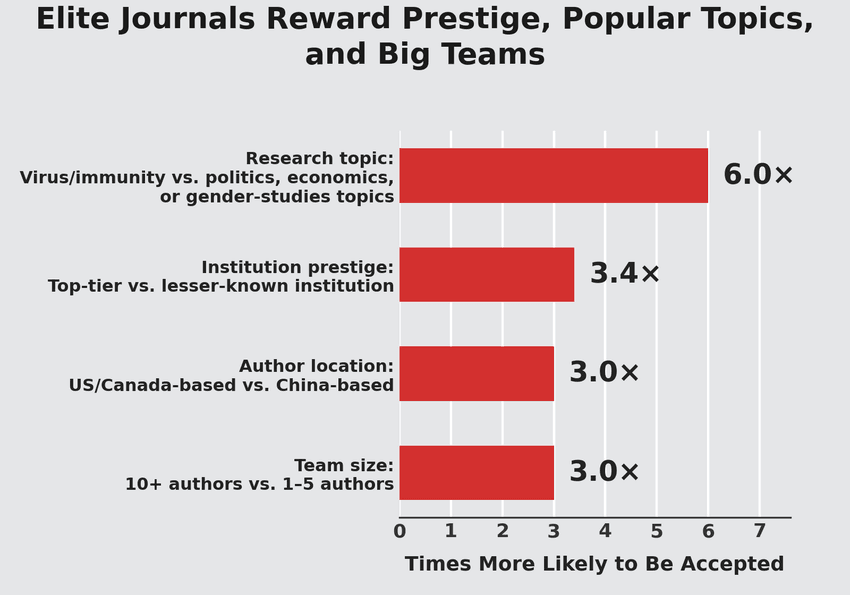
An analysis of 110,303 manuscripts submitted to Science and Science Advances between 2015 and 2020 found that research topic, institutional prestige, author location, and team size each shaped a manuscript's odds of acceptance. Papers on viruses, infection, and immune-response topics were six times more likely to be accepted than those on politics, economics, or gender studies, the largest gap the analysis found.
110,303 manuscripts submitted to Science and Science Advances (2015–2020) analyzed
11.6 percent acceptance rate at top-tier institutions vs. 3.4 percent at lesser-known ones
6 times more likely to be accepted: papers on viruses/immunity vs. politics, economics, or gender studies
3 times more likely to be accepted: teams of 10+ authors vs. teams of 1–5
The pattern held across every dimension the team measured. Manuscripts from the most prestigious institutions were accepted 11.6 percent of the time, compared with 3.4 percent for papers from lesser-known institutions, more than a threefold gap. Authors based in China were more than three times less likely to be published than researchers at institutions in the US or Canada, and researchers with distinctly Chinese names faced a similar disadvantage even when they worked at US institutions, suggesting the bias tracked perceived identity as much as geography. Papers with 10 or more coauthors were three times as likely to be accepted as those with five or fewer authors.
Continue reading below...
Like this story? Sign up for FREENewsletter updates:
Latest science news storiesTopic-tailored resources and eventsCustomized newsletter content
Manuscripts with women serving as corresponding author were accepted at a slightly lower rate than comparable papers led by men, a gap the authors estimated cost about 23 women-led papers a year at Science alone. “The fact that we find only a very marginal association with gender is in some sense reassuring,” Clauset said in the press release. “But the number is still not zero.”
Why It Matters: Peer Review Isn't the Meritocracy Scientists Assume
Clauset and his team were careful to note that their findings are correlational, not causal: institutional prestige, funding, and access to established collaborators are tangled together in ways submission data alone cannot fully untangle. But the size and consistency of the gaps, replicated across two journals with different acceptance thresholds and five years of data, complicate the assumption that peer review at elite general-science journals functions as a pure meritocracy. “With the rise of AI slop and the ability to mass produce junk science, the role of established gatekeepers like these elite journals becomes more important,” said Sam Zhang, a complex systems researcher at the University of Vermont and the study's first author, in the same press release. For early-career researchers and scientists outside a small circle of well-resourced institutions, the analysis offers a data-backed answer to a long-standing suspicion: getting published where it counts most depends only partly on the work itself.
Use of AI Declaration: This article was produced under The Scientist’sAI Editorial Policy.
Miles away from the closest ocean, marine microbes thrive in the red ice and mud around Blood Falls, offering clues to microbial adaptation and past climate events.
Explore how blood-based biomarkers perform across Alzheimer’s disease stages, including AIBL Study findings comparing p-Tau217 and other markers against amyloid-beta and tau PET reference standards.
Explore how super-resolution microscopy enables particle-level characterization of lipid nanoparticle composition, cargo loading, heterogeneity, and stability, providing complementary insights for formulation development and optimization.
The placements follow the commercial launch of Pyxa at the Advances in Genome Biology and Technology (AGBT) meeting in February 2026 and mark the company's transition from Early Access into global commercial availability.
The CellRaft AIR streamlines antibody discovery with imaging, functional screening, and gentle isolation of viable single B cells and hybridomas, helping verify monoclonality and identify high producing clones faster.
Load plasma directly into prefilled cartridges, no pretreatment, no ethanol. Under 30 minutes of instrument run time, up to 48 samples in parallel, with a high-throughput format also available.
Two Paige tools, powered by the Virchow pathology foundation model, are now available within a single image management workspace for oncology research.