AI has changed where the bottleneck sits in antibody discovery. The AI antibody discovery market is forecast to grow from USD 0.62 billion in 2026 to USD 1.88 billion by 2031, and generative models now produce candidates faster than labs can test them.1 Until recently, de novo design hit rates rarely exceeded 0.1%, so teams screened as many as a million designs to find binders.2,3 Newer models report hit rates near 16%, but every design still has to be expressed and measured, and model performance remains limited by the amount and type of experimental data available for training.2,4 Biointron launched RushDATA™ to close this gap, giving AI-driven discovery teams experimental data at the speed and scale of their design cycles.
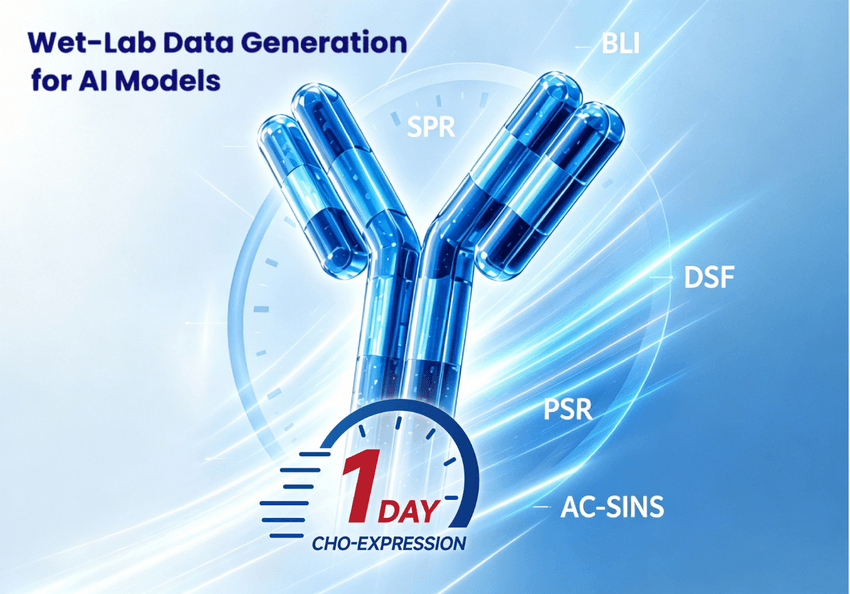
RushDATA™ is a high-throughput antibody data generation platform that turns AI- and ML-designed antibody sequences into experimentally validated, structured datasets in days rather than weeks. Built around Biointron’s 1-day transient CHO expression workflow, it integrates antibody expression, binding characterization, and optional developability profiling into one standardized process.
The platform takes submitted sequences through CHO expression and characterization, generating expression and assay data within the same workflow. Depending on the selected package, antibodies are screened directly from supernatant or purified before further characterization. Binding measurements include BLI- or SPR-based affinity analysis, with outputs such as KD, kon, and koff.
RushDATA™ is built for large candidate panels, with capacity exceeding 20,000 molecules per week. Custom workflows can be configured for different targets, modalities, and assay requirements. At this scale, teams test larger portions of a model-generated sequence set under standardized conditions, producing wet-lab data to validate predictions, compare candidates, and inform the next round of model training and design.
Each antibody generates a multidimensional experimental profile spanning expression, binding, analytical quality, and developability. Premium workflows add differential scanning fluorimetry (DSF) for Tm and Tonset, PSR-BVP for polyreactivity, and AC-SINS for self-interaction. These measurements flag candidates with unfavorable stability, nonspecific binding, or self-association before they advance into more resource-intensive development.
Because RushDATA™ uses CHO cells, data are generated in a mammalian expression system widely used for therapeutic antibody production. This lets teams evaluate expression behavior alongside binding and biophysical properties early in discovery.
RushDATA™ supports three core workflows. Basic provides rapid supernatant-level screening with high-throughput expression, BLI titer measurement, and two-point affinity analysis. Standard adds antibody purification, A280 concentration measurement, non-reducing cGE, and multi-point affinity characterization by BLI or SPR. Premium combines the Standard workflow with early developability profiling to support broader candidate risk assessment.
Results are returned as structured, model-ready datasets for both scientific analysis and computational workflows. RushDATA™ also supports API-based access, so order information and completed results can be retrieved as structured JSON and integrated into internal dashboards, automated pipelines, or AI-agent workflows.
Applications include wet-lab validation of AI-designed antibodies, AI/ML model training and benchmarking, large-scale candidate screening and ranking, sequence optimization, lead prioritization, and iterative design-build-test-learn workflows. By combining rapid CHO expression, high-throughput characterization, multidimensional assays, and structured data delivery, RushDATA™ connects computational antibody generation with experimental evidence at the scale AI-driven discovery requires.
Product Specifications:
| Specification | Value |
| Basic Package: Rapid Screening | High-throughput Expression (Supernatant) |
| Titer (BLI) | |
| Affinity (BLI, 2-points) | |
| Standard Package: Binding Characterization | High-throughput Expression + Purification |
| Concentration (A280) | |
| cGE (non-reducing) | |
| Affinity (BLI or SPR, multi-points) | |
| Premium Package: Developability Profiling | All Standard assays included, plus |
| DSF Tonset & Tm | |
| PSR-BVP | |
| AC-SINS |
New customers who order RushDATA™ by December 31, 2026 receive 50% off one 96-well plate, or the first plate free on orders of two or more plates. The offer is available outside of China. Details: https://www.biointron.com/promotions/rushdata-launch.html
References:
- Mordor Intelligence. AI in Antibody Discovery Market Size and Share: Growth Trends and Forecasts (2026 to 2031). 2026. https://www.mordorintelligence.com/industry-reports/ai-in-antibody-discovery-market
- Chai Discovery Team. Zero-shot antibody design in a 24-well plate. Technical report. 2025. https://www.chaidiscovery.com/news/introducing-chai-2
- Shanehsazzadeh A, et al. Unlocking de novo antibody design with generative artificial intelligence. bioRxiv. 2023. https://doi.org/10.1101/2023.01.08.523187
- Oxford Protein Informatics Group. Antibody developability datasets. July 30, 2025. https://www.blopig.com/blog/2025/07/antibody-developability-datasets/