As laboratories adopt digital tools, many face a persistent challenge: critical workflows remain split across systems that were not designed to work together. From experimental design to data analysis and reporting, scientists often navigate disconnected systems that introduce inefficiencies and obscure critical context. This lack of continuity can hinder reproducibility, slow collaboration, and make it difficult to maintain a clear record of how results were produced.

Ryan Cawood, DPhil
Cofounder Chief Executive Officer
Lab Thread
Increasingly, the field is shifting toward integrated digital environments that link each stage of the workflow into a cohesive whole. In this Innovation Spotlight, Ryan Cawood, the cofounder and chief executive officer of Lab Thread, explains the company’s integrated digital laboratory platform, which is designed to unify the fragmented tools that scientists rely on. Drawing on years of experience testing existing solutions, Cawood describes how this unified approach could streamline research and reduce duplication of effort. The result is a more cohesive workflow that supports reproducibility, compliance, and collaboration without adding complexity.
You worked at the bench before founding Lab Thread. What were some of the biggest day-to-day frustrations you encountered with digital lab tools?
I’ve spent the majority of my career focused on virology, genetically engineering viruses for different applications but mainly gene therapy. I did work for my Doctor of Philosophy degree at the University of Oxford, and then I founded a company called Oxford Genetics, which later traded as OXGENE.
Over that time, I tried many of the first-generation digital lab tools on the market, some of which are really good products. But they tend to be good at one, or in some cases two, distinct functions. This means that as a scientist, different parts of the workflow are handled by different software; you might use one tool for molecular biology, a different software for electronic lab notebook (ELN) records, and something else for project management. Each of these tools might work well on their own, but they don’t talk to each other. This means interrupting your workflow multiple times to manually re-enter the same data into different programs, having to pull reports from multiple software to present a progress report, and training every newcomer to the lab on several—not always terribly intuitive—software systems.
I felt a similar level of frustration from a CEO perspective, but with a different cause. As a company grows and more layers get added between the bench and leadership teams, it gets harder to keep your finger on the pulse of everything going on. We were paying for multiple software subscriptions, but we still couldn’t get a quick read on the health of any one project, understand who was working on what, or see at a glance where all the data was stored.
That is where the idea of the “digital thread” behind Lab Thread came from—to bring all the elements of the laboratory workflow together and connect them within a single system.

By connecting ELN, LIMS, and molecular biology tools within one interface, Lab Thread enables scientists to track experiments, data, and samples seamlessly from planning to analysis.
©iStock, Jacob Wackerhausen
What does Lab Thread’s digital workflow look like in practice, and how can scientists experience it?
We’re really excited to be launching the first full live version of Lab Thread at the end of April 2026. We’ve worked really hard to make this intuitive and straightforward, to make it easy for scientists to adopt and use without slowing them down. We want it to be love at first click, so we’re offering everyone a 30-day free trial—no credit card details necessary. We’re also working on some exciting subscriber benefits and partner programs to unlock further value for subscribers once the trial is over. These benefits will also be available to anyone who signs up for the free academic plan.
Our goal with Lab Thread is to develop a truly frictionless digital workflow. This won’t necessarily all be in place by the time we launch, but we will lay foundations that we can continue to build on and launch a set of core modules that we hope scientists will genuinely enjoy using.
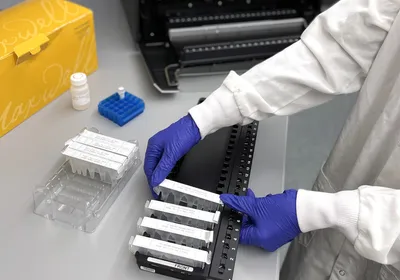
Ultimately, I see a truly frictionless digital workflow starting before a scientist even steps foot in the lab. They’re at their desk, or even at home, designing a plasmid or planning a restriction digest. They might look at the project list and realize that one of their teammates designed a nearly identical plasmid last week. Rather than starting from scratch, they can request that their colleague shares their design. The scientist can then quickly implement the edits they need to fit their experiment and perhaps run a quick digest simulation to check that it’s going as planned before they move over to the bench. At the bench, the scientist can pick up their tablet and hit “start restriction digest” in the lab processes module. This triggers a pre-filled form to pop up with their experimental details already loaded, such as plasmid name, buffer type, and enzyme volumes. The experimental metadata is collected effortlessly. When the scientist completes the experiment and generates the sample, a click of a button attaches the plasmid sequence and protocol to the project file. They update the ELN with data, results, and analysis and store the sample safely in the freezer, logging its location in the laboratory information management system (LIMS) module, which they then also attach to the central project file. At the end of the day, the scientist completes their ELN and hits “send for approval.” Their supervisor might be on the train home when their phone pings, alerting them that one of their team has sent a record for approval. The supervisor can pull up the details and attachments, ask a question, make a comment, and reject or approve that record—even attach an electronic signature—from anywhere.
How can digital systems help address issues with reproducibility and improve collaboration?
Standardization is the key to reproducibility. If you can standardize how teams record and run their experiments, then when something works, or doesn’t, you can look for the subtle differences that explain why. That’s where the Lab Processes module we’re developing comes in.
This will allow teams to create standard forms for the workflows that everyone in the organization uses, while allowing individual scientists to easily record the small variations that inevitably occur, such as incubation time, water bath temperature, cell count, or confluence at harvest. If the metadata is recorded consistently, you can later run a query to see why one experiment failed and another one worked, and the system will identify any differences in the process. Eventually, that data could be analyzed using AI to draw more definitive conclusions, such as whether the experiment works every time you run the experiment and incubate for 90 seconds or fails if you only incubate for 60 seconds.
Having a fully connected digital record of every experiment will make it much easier to reproduce results and support research continuity in teams. Imagine a new team member joins the lab and takes over a project. Instead of a messy freezer filled with poorly organized samples and some scribbles in a lab book, they’ve got a complete history of every experimental plan connected to the protocol, variables tested, results, and sample location. It will be much quicker and easier to pick up and progress that project.
Why do you think some researchers are still hesitant to fully embrace digital lab management? What might persuade them to make the change?
I suspect that most hesitation to adopt digital lab management tools is really a fear of being slowed down while they make the transition, learn the system, and optimize it for their workflow. If at any point using software starts to take too long or interrupt their workflow, they’ll revert to pen and paper. And in some labs, for example small academic groups where everyone is talking to each other daily, that may not be optimal, but it works well enough. When those teams become larger organizations with 20, 50, or 100 people, that alignment starts to break down, and paper just doesn’t scale well enough.
There’s also a cost element. If you must pay for five different subscriptions to cover every step of your workflow, that can soon add up and become a barrier. That’s why we think Lab Thread provides such good value. We’ve worked hard to deliver a premium product at an accessible price point—we even have a free-forever version of the software for small academic labs of up to 5 users— to make sure that the kind of digital best practice that Lab Thread supports is accessible to everyone.
How do you think the digital laboratory environment will evolve over the next five to ten years, particularly for molecular biology research? What changes will have the biggest effect on how scientists actually work?
I don’t think the basics of lab work will really change over the next 5-10 years, but scientists’ expectations of how software will support them absolutely will. AI will obviously have a big impact—accelerating analysis, building in efficiencies, and so forth. That’s all changing quickly, and it’s our job as software developers to not just keep up but try to get ahead of that.