Collins seen as boon to NIH

It would be difficult to find a more universally lauded and liked researcher than geneticist Francis Collins, who the Obama administration linkurl:nominated;http://www.the-scientist.com/blog/display/55818/ yesterday (July 8) to take the reins at the National Institutes of Health. Collins led the US government's Human Genome Project in his time as director of the NIH's National Human Genome Research Institute. Francis CollinsImage: WikipediaAlmost immediately after the announcement of Collins's

Written byBob Grant
| 2 min read

Register for free to listen to this article
Listen with Speechify
0:00
2:00
Share
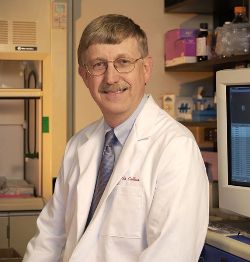
It would be difficult to find a more universally lauded and liked researcher than geneticist Francis Collins, who the Obama administration linkurl:nominated;http://www.the-scientist.com/blog/display/55818/ yesterday (July 8) to take the reins at the National Institutes of Health. Collins led the US government's Human Genome Project in his time as director of the NIH's National Human Genome Research Institute.
Francis Collins
Image: Wikipedia
Almost immediately after the announcement of Collins's nomination was made, the praise and well-wishes started pouring in from the usual cast of science advocates. A sampling of the more glowing endorsements: "He is an exceptional scientist, administrator, and communicator," wrote Association of American Medical Colleges president Darrell Kirch in a linkurl:statement.;http://www.aamc.org/newsroom/pressrel/2009/090708a.htm "His skillful direction of [the Human Genome Project] -- one of the greatest technical, scientific, and management accomplishments of our lifetime -- is just one example of the expertise he will bring to the NIH and its 27 institutes and centers." "It is a perfect nomination," enthused John Porter, former Congressman and chair of the science advocacy group Research!America, in a linkurl:statement.;http://www.researchamerica.org/release_09jul08_collins "Francis Collins understands all of science and has a broad vision for advancing human health through research. He is one of the leading scientists of our time and will provide the kind of strong, effective leadership that should always be the hallmark of the National Institutes of Health." Some in the scientific community may be wary of the idea of Collins -- who is an evangelical Christian -- leading the NIH, said linkurl:Robert Cook-Deegan,;http://www.genome.duke.edu/people/faculty/cookdeegan/ director of Duke University's Center for Genome Ethics, who chronicled the start of the Human Genome Project in his 1996 book, linkurl:__Gene Wars: Science, Politics, and the Human Genome__.;http://www.amazon.com/Gene-Wars-Science-Politics-Genome/dp/0393313999 "I suspect his religious beliefs cost him among some science groups," wrote Cook-Deegan in an email to __The Scientist__. But Cook-Deegan, continued that Collins's religious beliefs might actually improve his relations with Congress and the American public. "I believe it is good for NIH and good for the country to heal some of the ideological rifts that have opened up in biomedical research policy," Cook-Deegan wrote. "[Collins] has strong connections among both parties and across the ideological spectrum. His commitment to Christianity builds trust with many policy makers and constituencies who otherwise might distrust a molecular biologist of international stature." This may start Collins off on a good foot as he moves on to the Senate for confirmation hearings that are likely to approve his appointment. Let's just hope he's paid all his taxes!
**__Related stories:__***linkurl:Collins tapped to lead NIH;http://www.the-scientist.com/blog/display/55818/
[8th July 2009]*linkurl:Report: Collins to lead NIH;http://www.the-scientist.com/blog/display/55733/
[26th May 2009]*linkurl:Francis Collins leaves NHGRI;http://www.the-scientist.com/blog/display/54701/
[28th May 2008]
Interested in reading more?

Become a Member of

The Scientist Logo
Receive full access to more than 35 years of archives, as well as TS Digest, digital editions of The Scientist, feature stories, and much more!
Already a member? Login Here

Meet the Author

  • From 2017 to 2022, Bob Grant was Editor in Chief of The Scientist, where he started in 2007 as a Staff Writer. Before joining the team, he worked as a reporter at Audubon and earned a master’s degree in science journalism from New York University. In his previous life, he pursued a career in science, getting a bachelor’s degree in wildlife biology from Montana State University and a master’s degree in marine biology from the College of Charleston in South Carolina. Bob edited Reading Frames and other sections of the magazine.

    View Full Profile
Share
Image of a woman with her hands across her stomach. She has a look of discomfort on her face. There is a blown up image of her stomach next to her and it has colorful butterflies and gut bacteria all swarming within the gut.
November 2025, Issue 1

Why Do We Feel Butterflies in the Stomach?

These fluttering sensations are the brain’s reaction to certain emotions, which can be amplified or soothed by the gut’s own “bugs".

View this Issue
Olga Anczukow and Ryan Englander discuss how transcriptome splicing affects immune system function in lung cancer.

Long-Read RNA Sequencing Reveals a Regulatory Role for Splicing in Immunotherapy Responses

Pacific Biosciences logo
Research Roundtable: The Evolving World of Spatial Biology

Research Roundtable: The Evolving World of Spatial Biology

Conceptual cartoon image of gene editing technology

Exploring the State of the Art in Gene Editing Techniques

Bio-Rad
Conceptual image of a doctor holding a brain puzzle, representing Alzheimer's disease diagnosis.

Simplifying Early Alzheimer’s Disease Diagnosis with Blood Testing

fujirebio logo

Products

Labvantage Logo

LabVantage Solutions Awarded $22.3 Million U.S Customs and Border Protection Contract to Deliver Next-Generation Forensic LIMS

The Scientist Placeholder Image

Evosep Unveils Open Innovation Initiative to Expand Standardization in Proteomics

OGT logo

OGT expands MRD detection capabilities with new SureSeq Myeloid MRD Plus NGS Panel











