Fake blood 2.0?

Newly created synthetic particles that mimic red blood cells may one day carry drug molecules and/or oxygen through bloodstreams, according to researchers linkurl:writing;http://www.pnas.org/cgi/doi/10.1073/pnas.090712710 in this week's issue of the __Proceedings of the National Academy of Sciences__ (__PNAS__). What's more, the team of scientists in Michigan and California say the particles could also be used to improve the resolution of magnetic resonance imaging.The synthetic red blood cells

Written byBob Grant
| 3 min read

Register for free to listen to this article
Listen with Speechify
0:00
3:00
Share
Newly created synthetic particles that mimic red blood cells may one day carry drug molecules and/or oxygen through bloodstreams, according to researchers linkurl:writing;http://www.pnas.org/cgi/doi/10.1073/pnas.090712710 in this week's issue of the __Proceedings of the National Academy of Sciences__ (__PNAS__). What's more, the team of scientists in Michigan and California say the particles could also be used to improve the resolution of magnetic resonance imaging.
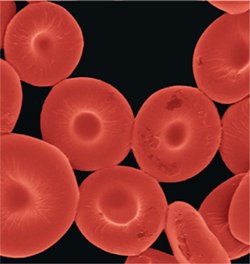
The synthetic red blood cells
that Mitragotri and his team developed

Image: Nishit Doshi
"It's a very nice paper and very exciting work," linkurl:Krishnendo Roy,;http://www.bme.utexas.edu/faculty/roy.cfm a biomedical engineer at the University of Texas at Austin who wasn't involved with the study, told __The Scientist__. "The beauty of their method is its simplicity." University of California, Santa Barbara, chemical engineer linkurl:Samir Mitragotri;http://drugdelivery.engr.ucsb.edu/Samir.html led the team of scientists and told __The Scientist__ that the blood cell-like particles could evolve into useful tools in the clinic. "What we got very excited about was making a structure with synthetic materials that begins to mimic a natural object," said Mitragotri. "If we can bridge the gap [between synthetic materials and living cells] it will open up tremendous opportunities for synthetic materials." Mitragotri said that he and his team tested the ability of the particles to carry oxygen, finding that they had a "comparable" oxygen-carrying capacity to actual red blood cells. He added that it may be possible in the future to link therapeutic agents destined for the vascular system, such as heparin, to the particles so that they can be easily distributed throughout the blood. The artificial blood cells, with attached iron oxide nanoparticles, could also one day improve MRI resolution by serving as contrast agents that provide a different imaging signal compared to the surrounding tissue, Mitragotri said. Mitragotri and his colleagues created the artificial red blood cells by first making tiny spheres out of a biodegradable polymer called poly(lactic acid-co-glycolide) (PLGA). They then exposed the spheres to isopropanol, which collapsed them into the discoid shape characteristic of red blood cells. The researchers then layered proteins -- either albumin or hemoglobin -- onto the doughnut-shaped disks, cross-linked the proteins to give them extra strength and stability, and finally dissolved away the PLGA template to leave only a strong but flexible shell of proteins in the shape and size (about 7 microns in diameter) of a red blood cell. Mitragotri and his team then tested the ability of the artificial cells to behave like real blood cells, passing them through glass capillary tubes that were narrower than the diameter of the particles and testing their oxygen-carrying capacity. They showed that the particles could carry about 90 percent of the oxygen real red blood cells can carry. They also showed that a drug-mimicking molecule could easily be loaded into and off of the artificial blood cells. "They conclusively demonstrated some stuff concerning oxygen-carrying capacity and the potential for drug release," linkurl:Patrick Doyle,;http://web.mit.edu/cheme/people/profile.html?id=11 a chemical engineer at the Massachusetts Institute of Technology who was not involved with the study, told __The Scientist__. But years of continued testing lie between Mitragotri's synthetic red blood cells and clinical application. Several questions, including how long the particles will remain in circulation, how the immune system will react to the synthetic blood cells, and how efficiently they transport oxygen, remain to be answered. Mitragotri said that his lab plans on answering these questions by studying the particles in model organisms, research that is set to begin soon. "Whether this is applicable in an in vivo setting," said Roy, "we won't know that for 3, 4, or 5 years." "I don't think these [clinical applications] are far off ideas, but you have to go through all the usual regulatory hurdles," said Doyle, noting that the synthetic cells might also be used to study how cellular aberrations, such as tumor cells, behave in the body. "Ultimately they can also be model systems, by which you can understand disease states of cells," he added.
**__Related stories:__***linkurl:Synthetic enzyme pioneer dies;http://www.the-scientist.com/blog/display/55863/
[27th July 2009]*linkurl:Artificial life, a step closer;http://www.the-scientist.com/blog/display/54212/
[24th January 2008]
Interested in reading more?

Become a Member of

The Scientist Logo
Receive full access to more than 35 years of archives, as well as TS Digest, digital editions of The Scientist, feature stories, and much more!
Already a member? Login Here

Meet the Author

  • From 2017 to 2022, Bob Grant was Editor in Chief of The Scientist, where he started in 2007 as a Staff Writer. Before joining the team, he worked as a reporter at Audubon and earned a master’s degree in science journalism from New York University. In his previous life, he pursued a career in science, getting a bachelor’s degree in wildlife biology from Montana State University and a master’s degree in marine biology from the College of Charleston in South Carolina. Bob edited Reading Frames and other sections of the magazine.

    View Full Profile
Share
Illustration of a developing fetus surrounded by a clear fluid with a subtle yellow tinge, representing amniotic fluid.
January 2026

What Is the Amniotic Fluid Composed of?

The liquid world of fetal development provides a rich source of nutrition and protection tailored to meet the needs of the growing fetus.

View this Issue
Human-Relevant In Vitro Models Enable Predictive Drug Discovery

Advancing Drug Discovery with Complex Human In Vitro Models

Stemcell Technologies
Redefining Immunology Through Advanced Technologies

Redefining Immunology Through Advanced Technologies

Ensuring Regulatory Compliance in AAV Manufacturing with Analytical Ultracentrifugation

Ensuring Regulatory Compliance in AAV Manufacturing with Analytical Ultracentrifugation

Beckman Coulter Logo
Conceptual multicolored vector image of cancer research, depicting various biomedical approaches to cancer therapy

Maximizing Cancer Research Model Systems

bioxcell

Products

Sino Biological Logo

Sino Biological Pioneers Life Sciences Innovation with High-Quality Bioreagents on Inside Business Today with Bill and Guiliana Rancic

Sino Biological Logo

Sino Biological Expands Research Reagent Portfolio to Support Global Nipah Virus Vaccine and Diagnostic Development

Beckman Coulter

Beckman Coulter Life Sciences Partners with Automata to Accelerate AI-Ready Laboratory Automation

Refeyn logo

Refeyn named in the Sunday Times 100 Tech list of the UK’s fastest-growing technology companies











