A New Species of Gecko Defensively Sheds Its Scales

Geckolepis megalepis escapes its predators by rapidly detaching its fish-like scales.

Written byDiana Kwon
| 1 min read

Register for free to listen to this article
Listen with Speechify
0:00
1:00
Share

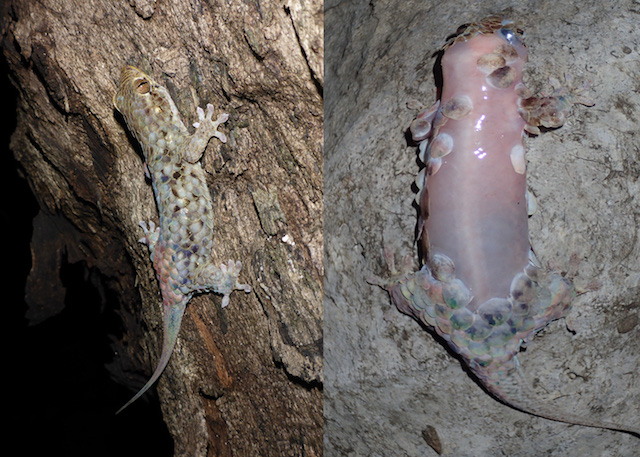
FRANK GLAWGeckolepis megalepis, a gecko from Madagascar, has a unique survival strategy. When under attack the lizard sheds it skin, leaving predators with a mouthful of scales as it runs away with its pink flesh exposed. Researchers described this new species in PeerJ on Tuesday (February 7).

Tearaway skin is not the only thing that makes these creatures unique—they are also one of only a few species of gecko that have large, fish-like scales. "What's really remarkable though is that these scales—which are really dense and may even be bony, and must be quite energetically costly to produce—and the skin beneath them tear away with such ease, and can be regenerated quickly and without a scar," Mark Scherz, study co-author and a doctoral student at the Ludwig Maximilian University of Munich, said in a statement.

These skin-shedding creatures are not easy specimens to study. "Generally, what we do is lure the geckos into a container or plastic bag, so that we have the minimum possible contact with them," Scherz told Live Science. ...

Interested in reading more?

Become a Member of

The Scientist Logo
Receive full access to more than 35 years of archives, as well as TS Digest, digital editions of The Scientist, feature stories, and much more!
Already a member? Login Here

Related Topics

Meet the Author

  • Diana is a freelance science journalist who covers the life sciences, health, and academic life. She’s a regular contributor to The Scientist and her work has appeared in several other publications, including Scientific American, Knowable, and Quanta. Diana was a former intern at The Scientist and she holds a master’s degree in neuroscience from McGill University. She’s currently based in Berlin, Germany.

    View Full Profile
Share
Illustration of a developing fetus surrounded by a clear fluid with a subtle yellow tinge, representing amniotic fluid.
January 2026, Issue 1

What Is the Amniotic Fluid Composed of?

The liquid world of fetal development provides a rich source of nutrition and protection tailored to meet the needs of the growing fetus.

View this Issue
Skip the Wait for Protein Stability Data with Aunty

Skip the Wait for Protein Stability Data with Aunty

Unchained Labs
Graphic of three DNA helices in various colors

An Automated DNA-to-Data Framework for Production-Scale Sequencing

illumina
Exploring Cellular Organization with Spatial Proteomics

Exploring Cellular Organization with Spatial Proteomics

Abstract illustration of spheres with multiple layers, representing endoderm, ectoderm, and mesoderm derived organoids

Organoid Origins and How to Grow Them

Thermo Fisher Logo

Products

Brandtech Logo

BRANDTECH Scientific Introduces the Transferpette® pro Micropipette: A New Twist on Comfort and Control

Biotium Logo

Biotium Launches GlycoLiner™ Cell Surface Glycoprotein Labeling Kits for Rapid and Selective Cell Surface Imaging

Colorful abstract spiral dot pattern on a black background

Thermo Scientific X and S Series General Purpose Centrifuges

Thermo Fisher Logo
Abstract background with red and blue laser lights

VANTAstar Flexible microplate reader with simplified workflows

BMG LABTECH










