Waste-Management Consultant

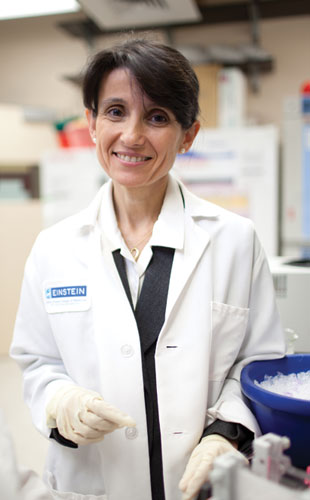
By audaciously pursuing an abandoned area of research, Ana María Cuervo discovered how cells selectively break down their waste, and revealed the health consequences when that process malfunctions.

Written byMegan Scudellari
| 9 min read

Register for free to listen to this article
Listen with Speechify
0:00
9:00
Share

ANA MARIA CUERVO
Robert and Renee Belfer Chair for the Study
of Neurodegenerative Diseases
Professor of Developmental and Molecular Biology Albert Einstein College of Medicine
Bronx, New York
COURTESY OF ALBERT EINSTEIN COLLEGE OF MEDICINE
As a medical student, Ana María Cuervo assumed that students in her class who got top scores on the second-year exam would get their pick of research opportunities, so she studied hard, aced the test, and identified a biochemistry laboratory she wanted to join. Only then did she find out her assumption was wrong: lower-scoring students had a choice; top exam scorers were assigned to labs.

It was 1986 at the University of Valencia in Spain, and Cuervo was placed in a lab studying nerve conduction. “Nobody wanted to go into that lab,” says Cuervo. “I thought, ‘Oh my god, I’m going to be putting electrodes into the tails of rats. How uncool is that?’”

But today, Cuervo looks back on that moment as a positive turning point in her career. The head of the lab, Joaquín Romá, became Cuervo’s first mentor and fueled her devotion to research. “He taught us to formulate a question and test it, but the answer wasn’t the important part,” she says. Since Cuervo was addicted to Diet Coke, for example, Romá had her perform a study on the effect of caffeine on nerve conduction. Cuervo ...

Interested in reading more?

Become a Member of

The Scientist Logo
Receive full access to digital editions of The Scientist, as well as TS Digest, feature stories, more than 35 years of archives, and much more!
Already a member? Login Here
Illustration of a developing fetus surrounded by a clear fluid with a subtle yellow tinge, representing amniotic fluid.
January 2026

What Is the Amniotic Fluid Composed of?

The liquid world of fetal development provides a rich source of nutrition and protection tailored to meet the needs of the growing fetus.

View this Issue
Human-Relevant In Vitro Models Enable Predictive Drug Discovery

Advancing Drug Discovery with Complex Human In Vitro Models

Stemcell Technologies
Redefining Immunology Through Advanced Technologies

Redefining Immunology Through Advanced Technologies

Ensuring Regulatory Compliance in AAV Manufacturing with Analytical Ultracentrifugation

Ensuring Regulatory Compliance in AAV Manufacturing with Analytical Ultracentrifugation

Beckman Coulter Logo
Conceptual multicolored vector image of cancer research, depicting various biomedical approaches to cancer therapy

Maximizing Cancer Research Model Systems

bioxcell

Products

Refeyn logo

Refeyn named in the Sunday Times 100 Tech list of the UK’s fastest-growing technology companies

Parse Logo

Parse Biosciences and Graph Therapeutics Partner to Build Large Functional Immune Perturbation Atlas

Sino Biological Logo

Sino Biological's Launch of SwiftFluo® TR-FRET Kits Pioneers a New Era in High-Throughout Kinase Inhibitor Screening

SPT Labtech Logo

SPT Labtech enables automated Twist Bioscience NGS library preparation workflows on SPT's firefly platform