A group of intricately folded origami swans, with one soaring above, symbolizing revolutionary ideas.
Podcast

Rise of the Nanorobots

Björn Högberg explains how his team engineered a DNA origami nanorobot that activates only in tumors to trigger cancer cell death.

Share

For centuries, people have relied on materials such as concrete, steel, and wood for the construction of buildings, bridges, and other structures. However, researchers have started exploring a far less conventional material for building therapeutics at the molecular level—DNA.
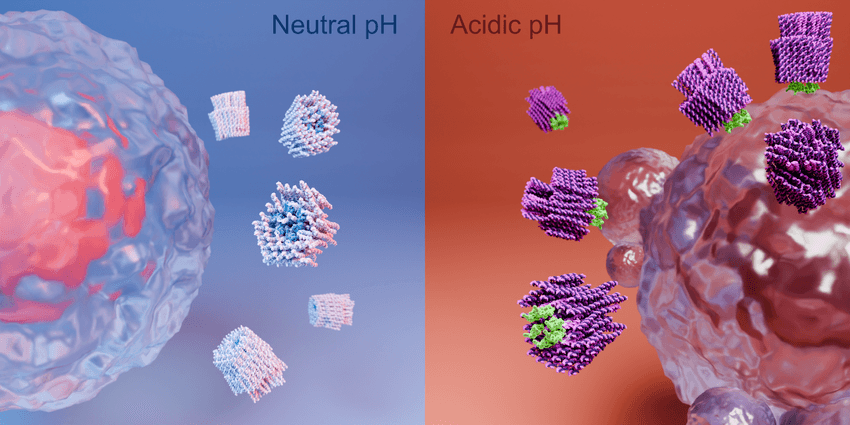
An illustration of DNA nanorobots responding differently in neutral and acidic environments.

DNA nanorobots conceal their cytotoxic ligand pattern in neutral conditions, preventing interaction with healthy cells. However, these nanostructures display the hexagonal ligand pattern in acidic tumor environments, triggering cell death.

Boxuan Shen, Högberg lab, Karolinska Institute

In this episode, Charlene Lancaster from The Scientist spoke with Björn Högberg, a professor of biophysics at the Karolinska Institute, to learn how his team is developing DNA-based nanorobots to fight cancer.

More on this topic: Coming Into the Fold: DNA Origami

The Scientist Speaks is a podcast produced by The Scientist’s Creative Services team. Our podcast is by scientists and for scientists. Once a month, we bring you the stories behind news-worthy molecular biology research. This month’s episode is sponsored by Crown Bioscience.


Speaker:

Björn Högberg, PhD


Björn Högberg, PhD
Professor and Departmental Head
Department of Medical Biochemistry and Biophysics
Karolinska Institute


Headquartered in California, Crown Bioscience is a global contract research organization providing discovery, preclinical, and translational platforms and services to advance oncology and immuno-oncology. The company delivers high-quality, integrated solutions and offers in vivo, in vitro, ex vivo, and in silico services. They work closely with clients to assess the efficacy and pharmacological profile of drug candidates before clinical development. Their goal is to deliver superior therapies that ensure patients receive the right treatment at the right time.


Sponsored by

  • Crown Bioscience Logo
Illustration of a developing fetus surrounded by a clear fluid with a subtle yellow tinge, representing amniotic fluid.
January 2026, Issue 1

What Is the Amniotic Fluid Composed of?

The liquid world of fetal development provides a rich source of nutrition and protection tailored to meet the needs of the growing fetus.

View this Issue
Skip the Wait for Protein Stability Data with Aunty

Skip the Wait for Protein Stability Data with Aunty

Unchained Labs
Graphic of three DNA helices in various colors

An Automated DNA-to-Data Framework for Production-Scale Sequencing

illumina
Exploring Cellular Organization with Spatial Proteomics

Exploring Cellular Organization with Spatial Proteomics

Abstract illustration of spheres with multiple layers, representing endoderm, ectoderm, and mesoderm derived organoids

Organoid Origins and How to Grow Them

Thermo Fisher Logo

Products

Brandtech Logo

BRANDTECH Scientific Introduces the Transferpette® pro Micropipette: A New Twist on Comfort and Control

Biotium Logo

Biotium Launches GlycoLiner™ Cell Surface Glycoprotein Labeling Kits for Rapid and Selective Cell Surface Imaging

Colorful abstract spiral dot pattern on a black background

Thermo Scientific X and S Series General Purpose Centrifuges

Thermo Fisher Logo
Abstract background with red and blue laser lights

VANTAstar Flexible microplate reader with simplified workflows

BMG LABTECH









