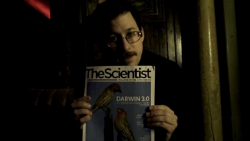
We Are (not) Scientists

Don't bother trying to figure out if the members of the rock band We Are Scientists are actually scientists. Don't even try to figure out what their name comes from -- they give a different explanation in practically every interview, sometimes claiming it came from a random string of letters that appeared during a game of Boggle. In fact, it's best not to take anything they say too seriously. Bassist Chris Cain holding our January, 2010 issueWith that, I set out to get my own tongue-in-cheek in

Written byAlison McCook
| 2 min read

Register for free to listen to this article
Listen with Speechify
0:00
2:00
Share
Don't bother trying to figure out if the members of the rock band We Are Scientists are actually scientists. Don't even try to figure out what their name comes from -- they give a different explanation in practically every interview, sometimes claiming it came from a random string of letters that appeared during a game of Boggle. In fact, it's best not to take anything they say too seriously.
Bassist Chris Cain holding our January, 2010 issue
With that, I set out to get my own tongue-in-cheek interview during the band's recent stopover at Philadelphia's Johnny Brenda's, promoting new songs and their 2008 album, Brain Thrust Mastery. One thing that's not in question in the band's success: since their 2005 hit album With Love and Squalor, We Are Scientists has sat atop the Indie Rock heap. You may have heard their big hits, including "Impatience" (a linkurl:video;http://www.youtube.com/watch?v=UH-RG1lWc0I for which featured bassist Chris Cain turning into a werewolf) and "Great Escape" (see linkurl:video;http://www.youtube.com/watch?v=nAxp4I6Nre4&feature=channel here). Even if they don't take interviews seriously, and make jokes about hookers and their glasses prescriptions between songs, they don't mess around with their music and performances, where Cain's calm energy complements the frenetic movements of guitarist and singer Keith Murray. Before their Philly show, Cain spoke to me (his supposedly first interview with a science publication) about their recent experiments, whether it's easier to get laid as a real scientist or as a rock musician in a band called We Are Scientists (the answer might surprise you), and which instrument Charles Darwin would play if he were in a rock band. At the end of the interview, Cain launches a formal request of biologists -- help give the band a mascot. The band is already heavily influenced by various species (see linkurl:the "influences" section;http://www.myspace.com/wearescientists on its MySpace page, normally reserved for musical influences), but he's looking for a species that isn't already "taken" that fans could associate with the group. (I humbly suggested the linkurl:octopus that used a coconut;http://news.nationalgeographic.com/news/2009/12/091214-octopus-carries-coconuts-coconut-carrying.html and the linkurl:hairless raccoon;http://www.nbcdfw.com/news/local-beat/Hide-Your-Goats-Alleged-Chupacabra-Found-in-North-Texas-82001187.html that people thought was the Chupacabra but I think he'd like to hear your suggestions as well.) FYI, the most plausible explanation for why the band calls itself We Are Scientists is a tribute to the song by influential band linkurl:Cap'n Jazz.;http://en.wikipedia.org/wiki/Cap%27n_Jazz Watch a clip from the interview below.
**__Related stories:__***linkurl:Crystals in lab, rock on stage;http://www.the-scientist.com/news/display/57489/
[3rd June, 2010]*linkurl:A cancerous melody;http://www.the-scientist.com/blog/display/55998/
[25th September 2009]*linkurl:Scientific song and dance;http://www.the-scientist.com/blog/display/56138/
[5th November 2009]
Interested in reading more?

Become a Member of

The Scientist Logo
Receive full access to more than 35 years of archives, as well as TS Digest, digital editions of The Scientist, feature stories, and much more!
Already a member? Login Here

Meet the Author

Share
Illustration of a developing fetus surrounded by a clear fluid with a subtle yellow tinge, representing amniotic fluid.
January 2026, Issue 1

What Is the Amniotic Fluid Composed of?

The liquid world of fetal development provides a rich source of nutrition and protection tailored to meet the needs of the growing fetus.

View this Issue
Skip the Wait for Protein Stability Data with Aunty

Skip the Wait for Protein Stability Data with Aunty

Unchained Labs
Graphic of three DNA helices in various colors

An Automated DNA-to-Data Framework for Production-Scale Sequencing

illumina
Exploring Cellular Organization with Spatial Proteomics

Exploring Cellular Organization with Spatial Proteomics

Abstract illustration of spheres with multiple layers, representing endoderm, ectoderm, and mesoderm derived organoids

Organoid Origins and How to Grow Them

Thermo Fisher Logo

Products

Brandtech Logo

BRANDTECH Scientific Introduces the Transferpette® pro Micropipette: A New Twist on Comfort and Control

Biotium Logo

Biotium Launches GlycoLiner™ Cell Surface Glycoprotein Labeling Kits for Rapid and Selective Cell Surface Imaging

Colorful abstract spiral dot pattern on a black background

Thermo Scientific X and S Series General Purpose Centrifuges

Thermo Fisher Logo
Abstract background with red and blue laser lights

VANTAstar Flexible microplate reader with simplified workflows

BMG LABTECH










