Ancient eyes head for the light

Simple communication between a pair of neighboring cells allows tiny marine worms to move toward light using a sensory organ believed to be an ancient precursor of the eye, according to a study out this week in Nature. "It's remarkable that a primitive organism of the ocean, a living marine zooplankton, has the sophisticated ability to move in response to light with a pigment-photoreceptor cell combination," linkurl:Russell Fernald,;http://www.stanford.edu/group/fernaldlab/index.shtml an evolu

Written byJennifer Evans
| 2 min read

Register for free to listen to this article
Listen with Speechify
0:00
2:00
Share
Simple communication between a pair of neighboring cells allows tiny marine worms to move toward light using a sensory organ believed to be an ancient precursor of the eye, according to a study out this week in Nature. "It's remarkable that a primitive organism of the ocean, a living marine zooplankton, has the sophisticated ability to move in response to light with a pigment-photoreceptor cell combination," linkurl:Russell Fernald,;http://www.stanford.edu/group/fernaldlab/index.shtml an evolutionary neuroethologist at Stanford who was not involved in the study, told The Scientist. He added that the paper provides "proof that a simple pair of cells can give directive information." The vertical migration of plankton in response to light constitutes the largest biomass transport on Earth. Researchers have believed that the eyespots of multicellular zooplankton larvae, comprised of a single photoreceptor and shading pigment cell, are responsible for phototaxis, or movement toward light, but the mechanism has never been identified. Eyespots allow organisms to sense the direction of light but not make out images. linkurl:Detlav Arendt,;http://www-db.embl.de/jss/EmblGroupsOrg/per_673.html a molecular biologist at the European Molecular Biology Laboratory in Germany and senior author on the Nature study, spent the past 10 years studying eyespots in the marine rag-worm Platynereis. The rag-worm is covered in cilia, which it uses to propel itself forward in a helical fashion towards light.

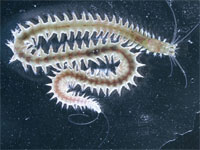
The eyespots of Platynereis larvae allow it to move toward light

In linkurl:2001,;http://www.ncbi.nlm.nih.gov/pubmed/11604122?ordinalpos=3&itool=EntrezSystem2.PEntrez.Pubmed.Pubmed_ResultsPanel.Pubmed_DefaultReportPanel.Pubmed_RVDocSum Arendt's group discovered that the gene linkurl:Pax6,;http://www.the-scientist.com/article/display/19190/ which controls the development of eyes and other sensory organs in humans, was also active in rag-worm eyespots, confirming early traces of more sophisticated eye systems. In linkurl:2004,;http://www.ncbi.nlm.nih.gov/pubmed/15514158?ordinalpos=&itool=EntrezSystem2.PEntrez.Pubmed.Pubmed_ResultsPanel.SmartSearch&log$=citationsensor they identified two types of photoreceptor cells in the rag-worm -- the rhabdomeric photoreceptors in the eyespots and ciliary photoreceptors in the brain. In their latest set of experiments, the researchers used linkurl:immunohistochemistry;http://www.the-scientist.com/article/display/17060/ to trace the photoreceptor axons directly to neighboring ciliated cells in Platynereis larvae. "Essentially there is no nervous system in between" the photoreceptors and ciliated cells, Arendt said. "The axons contact ciliated cells in the neighborhood." Double whole-mount in situ hybridization revealed that photoreceptors and ciliated cells were communicating via the neurotransmitter acetylcholine. Blocking the acetylcholine receptor prevented the larvae's helical movement toward light without affecting the speed at which they swam, revealing the direct sensory-motor coupling between the photoreceptor and the cilia cells. To understand how light exposure influences the movement of cilia, they selectively illuminated one of the organism's two eyespots and recorded the force of cilia beats. The light activated five ciliated cells neighboring the eyespot, which resulted in a slowed beat with more force on one side of the larvae without affecting the cilia on the opposing side of the larvae, leading the larvae to make a helical turn. linkurl:John Spudich,;http://www.uth.tmc.edu/bmb/faculty/Spudich/Spudich.html a photobiologist at the University of Texas in Houston who was not involved in the study, told The Scientist that Arendt's "elegant study" identifies a photosensory mechanism that may be the "key evolutionary intermediate suggested by Charles Darwin's reflections on the evolution of human vision." Previous studies in Spudich's lab showed the unicellular algae Chlamydomonas also controls helical phototactic swimming by modulating asymmetric ciliary beating. The study also has ecological implications, Arendt said. "Phototaxis is of important component of marine life," he said. "If you want to understand anything in the ecosystem, including planet climate change, you need to start by understanding the mechanism by which [phototaxis is taking place]." Image courtesy of Arendt, D. and Jekely, G., EMBLThis post has been updated from a previous post to correctly identify Russell Fernald of Stanford University. The Scientist regrets the error.
Interested in reading more?

Become a Member of

The Scientist Logo
Receive full access to more than 35 years of archives, as well as TS Digest, digital editions of The Scientist, feature stories, and much more!
Already a member? Login Here

Meet the Author

Share
Image of a man in a laboratory looking frustrated with his failed experiment.
February 2026

A Stubborn Gene, a Failed Experiment, and a New Path

When experiments refuse to cooperate, you try again and again. For Rafael Najmanovich, the setbacks ultimately pushed him in a new direction.

View this Issue
Human-Relevant In Vitro Models Enable Predictive Drug Discovery

Advancing Drug Discovery with Complex Human In Vitro Models

Stemcell Technologies
Redefining Immunology Through Advanced Technologies

Redefining Immunology Through Advanced Technologies

Ensuring Regulatory Compliance in AAV Manufacturing with Analytical Ultracentrifugation

Ensuring Regulatory Compliance in AAV Manufacturing with Analytical Ultracentrifugation

Beckman Coulter logo
Conceptual multicolored vector image of cancer research, depicting various biomedical approaches to cancer therapy

Maximizing Cancer Research Model Systems

bioxcell

Products

Sino Biological Logo

Sino Biological Pioneers Life Sciences Innovation with High-Quality Bioreagents on Inside Business Today with Bill and Guiliana Rancic

Sino Biological Logo

Sino Biological Expands Research Reagent Portfolio to Support Global Nipah Virus Vaccine and Diagnostic Development

Beckman Coulter

Beckman Coulter Life Sciences Partners with Automata to Accelerate AI-Ready Laboratory Automation

Refeyn logo

Refeyn named in the Sunday Times 100 Tech list of the UK’s fastest-growing technology companies