Cancer's shield seen, stripped

Researchers find - and reverse - tumors' ability to hide from the immune system

Written byMegan Scudellari
| 2 min read

Register for free to listen to this article
Listen with Speechify
0:00
2:00
Share
Researchers have identified how cancer escapes detection by the immune system -- support cells surrounding a tumor protect it from triggering an immune reaction. The research, published this week in linkurl:Science,;http://www.sciencemag.org/ may ultimately provide a new therapeutic target to activate the body's natural defenses against malignant cells. "The beauty of this article is that it clearly connects certain stromal cells of the tumor microenvironment to the immune system," said linkurl:Hans Schreiber,;http://biomed.uchicago.edu/common/faculty/schreiber.html an immunologist at the University of Chicago who was not involved in the study. "It was very well done."
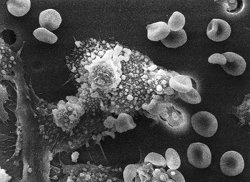
Macrophages of the immune system
attacking a cancer cell
linkurl:Susan Arnold;http://commons.wikimedia.org/wiki/File:Macs_killing_cancer_cell.jpg
Researchers have long wondered how cancer evades attacks by the immune system, trained to recognize and destroy all foreign material. In the past, even when an immune response is mounted in an animal with cancer, the tumor itself remains relatively unscathed, since neighboring immune cells fail to attack. "It was something going on inside the tumor that was suppressing the immune reaction," said linkurl:Douglas Fearon,;http://www.immunology.cam.ac.uk/directory/profile.php?DFearon an immunologist at the University of Cambridge and senior author on the paper. Cancer cells sit in a bed of nonmalignant connective tissue called stroma. Fearon and colleagues hypothesized that a subset of stromal cells expressing fibroblast activation protein (FAP) might be involved in keeping the immune system at bay, since FAP expressing cells are also present in the uterus, placenta, and areas of chronic inflammation, all locations where the body is trying to subdue or control an immune response. The team bred transgenic mice with a genetic switch to kill FAP expressing cells when exposed to diptheria toxin and injected the mice with tumors. Two to three weeks later, when the tumors were well established, the researchers eliminated the animals' FAP+ cells. Within 48 hours, the mice had mounted an immune response that killed 80 to 90 percent of the tumors. As a control, the researchers performed the same experiment in mice without an immune system, and removing the FAP+ cells had no effect on the tumors. "We had to combine both depleting FAP+ cells and an immune response to the tumor," said Fearon. "That proved that the tumor death caused by [loss of] FAP+ cells was mediated by the immune system."The team is planning to validate their findings in a spontaneous tumor mouse model developed by linkurl:researchers at Cancer Research UK,;http://www.cambridgecancer.org.uk/research/loc/cambridge/ccri/tuvesond/?view=CRI&source=research one that better models tumor development in humans. The paper demonstrates that FAP+ stromal cells are an important target for cancer drugs, said Schreiber, who wrote an accompanying perspective in Science. But though antibodies already exist for FAP, the challenge will be targeting drugs to the cells without affecting the many other nonmalignant cells that express FAP, he cautioned.But if researchers can determine how the FAP+ cells are getting to tumors or how they suppress an immune response, they may be able to either block the cells from getting to a tumor or from suppressing the immune system once there. "At least now there is a very specific cell type we can analyze that might be accounting for suppressing immune reactions in a tumor," said Fearon. "It's a step."Kraman, M. et al., "Suppression of Antitumor Immunity by Stromal Cells Expressing Fibroblast Activation Protein-alpha," Science, 330:827-30, 2010.
**__Related stories:__***linkurl:A cancer vaccine -- that works?;http://www.the-scientist.com/blog/display/56188/
[25th November 2009] *linkurl:A complement for cancer?;http://www.the-scientist.com/blog/display/55057/
[29th September 2008] *linkurl:Is autoimmunity like cancer?;http://www.the-scientist.com/blog/display/54273/
[2nd February 2008]
Interested in reading more?

Become a Member of

The Scientist Logo
Receive full access to more than 35 years of archives, as well as TS Digest, digital editions of The Scientist, feature stories, and much more!
Already a member? Login Here

Meet the Author

Share
Illustration of a developing fetus surrounded by a clear fluid with a subtle yellow tinge, representing amniotic fluid.
January 2026

What Is the Amniotic Fluid Composed of?

The liquid world of fetal development provides a rich source of nutrition and protection tailored to meet the needs of the growing fetus.

View this Issue
Human-Relevant In Vitro Models Enable Predictive Drug Discovery

Advancing Drug Discovery with Complex Human In Vitro Models

Stemcell Technologies
Redefining Immunology Through Advanced Technologies

Redefining Immunology Through Advanced Technologies

Ensuring Regulatory Compliance in AAV Manufacturing with Analytical Ultracentrifugation

Ensuring Regulatory Compliance in AAV Manufacturing with Analytical Ultracentrifugation

Beckman Coulter Logo
Conceptual multicolored vector image of cancer research, depicting various biomedical approaches to cancer therapy

Maximizing Cancer Research Model Systems

bioxcell

Products

Refeyn logo

Refeyn named in the Sunday Times 100 Tech list of the UK’s fastest-growing technology companies

Parse Logo

Parse Biosciences and Graph Therapeutics Partner to Build Large Functional Immune Perturbation Atlas

Sino Biological Logo

Sino Biological's Launch of SwiftFluo® TR-FRET Kits Pioneers a New Era in High-Throughout Kinase Inhibitor Screening

SPT Labtech Logo

SPT Labtech enables automated Twist Bioscience NGS library preparation workflows on SPT's firefly platform