


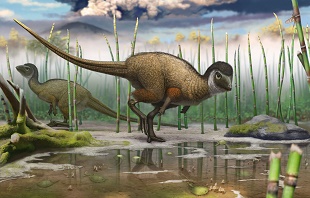
 SCIENCE, ANDREY ATUCHINFeather-clad dinosaurs may have been the norm rather than a rarity restricted to certain groups, according to a study published last week (July 25) in Science. The prevailing evidence to date had suggested that only theropods—two-legged carnivores such as Velociraptor and Yutyrannus—had plumage. But this latest analysis of a 160-million-year-old ornithischian fossil suggests feathers were far more common, and arose earlier than previously thought.
A group of researchers led by Pascal Godefroit of the Royal Belgian Institute of Natural Sciences analyzed Kulindadromeus zabaikalicus, a Jurassic ornithischian dinosaur from Siberia that had both feathers and scales. “For the first time we have a feathered dinosaur that is far from the lineage leading to birds,” Godefroit told Science News. “It means that all dinosaurs were potentially covered by feathers.”
The approximately 5-foot-long bipedal herbivore had a small head, pointed tail, and likely foraged for food in swamps using its front limbs. The researchers discovered evidence for three kinds of feathers on the specimen: bristle-like filaments on its head, back, and body; downy, bird-like plumage on the tops of its limbs; and ribbon-like bundles on the animal’s lower legs. “There’s nothing like ...












