Human Presence Influences Chimps’ Hunting Habits

Researchers find differences in predatory behavior between a long-observed chimp tribe and a recently habituated one.

Written byDiana Kwon
| 1 min read

Register for free to listen to this article
Listen with Speechify
0:00
1:00
Share

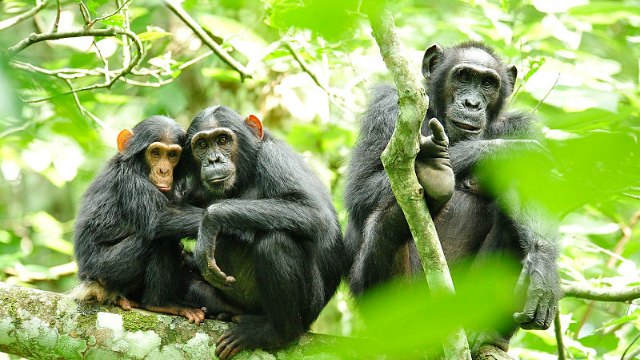
WIKIMEDIA, USAID AFRICA BUREAUTwo groups of chimpanzees living side-by-side in Uganda’s Budongo Forest display significant differences in hunting habits. This may be the result of years of human observation, according to a study published last week (June 21) in PLOS ONE.

To see whether human presence affects chimpanzees’ hunting habits, researchers analyzed hunting behavior in two adjacent primate communities: the Sonso chimps, which have been observed since 1991, and the Waibira chimps, a group habituated much later, in 2011. The team found that Sonso chimps preferentially hunted colobus monkeys while Waibira chimps were much less selective—they preyed on both colobus monkeys and duiker, a type of forest antelope.

“The main thing that’s different about them right now is how used to having humans follow them around the forest they are,” study coauthor Catherine Hobaiter, a research scientist at the University of St. Andrews in the U.K., tells the BBC. The two groups live in similar habitats, and researchers have also found evidence for genetic exchange between ...

Interested in reading more?

Become a Member of

The Scientist Logo
Receive full access to more than 35 years of archives, as well as TS Digest, digital editions of The Scientist, feature stories, and much more!
Already a member? Login Here

Related Topics

Meet the Author

  • Diana is a freelance science journalist who covers the life sciences, health, and academic life. She’s a regular contributor to The Scientist and her work has appeared in several other publications, including Scientific American, Knowable, and Quanta. Diana was a former intern at The Scientist and she holds a master’s degree in neuroscience from McGill University. She’s currently based in Berlin, Germany.

    View Full Profile
Share
Illustration of a developing fetus surrounded by a clear fluid with a subtle yellow tinge, representing amniotic fluid.
January 2026

What Is the Amniotic Fluid Composed of?

The liquid world of fetal development provides a rich source of nutrition and protection tailored to meet the needs of the growing fetus.

View this Issue
Human-Relevant In Vitro Models Enable Predictive Drug Discovery

Advancing Drug Discovery with Complex Human In Vitro Models

Stemcell Technologies
Redefining Immunology Through Advanced Technologies

Redefining Immunology Through Advanced Technologies

Ensuring Regulatory Compliance in AAV Manufacturing with Analytical Ultracentrifugation

Ensuring Regulatory Compliance in AAV Manufacturing with Analytical Ultracentrifugation

Beckman Coulter Logo
Conceptual multicolored vector image of cancer research, depicting various biomedical approaches to cancer therapy

Maximizing Cancer Research Model Systems

bioxcell

Products

Refeyn logo

Refeyn named in the Sunday Times 100 Tech list of the UK’s fastest-growing technology companies

Parse Logo

Parse Biosciences and Graph Therapeutics Partner to Build Large Functional Immune Perturbation Atlas

Sino Biological Logo

Sino Biological's Launch of SwiftFluo® TR-FRET Kits Pioneers a New Era in High-Throughout Kinase Inhibitor Screening

SPT Labtech Logo

SPT Labtech enables automated Twist Bioscience NGS library preparation workflows on SPT's firefly platform