


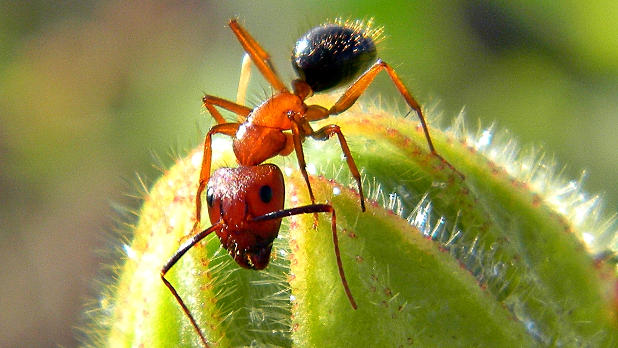
 A carpenter antWIKIMEDIA, BOB PETERSONTweaking the proteins that control how tightly DNA is wound can dramatically alter behavior in Florida carpenter ant workers, according to researchers who manipulated the biochemistry of the insects. Worker ants called majors—larger individuals that typically guard the colony—can be made to act more like so-called minors—smaller ants that serve as foragers—simply by introducing chemicals that alter chromatin proteins called histones without changing underlying DNA. “These are long-term, permanent changes that occur when we inject the brain with these chemicals,” University of Pennsylvania biologist Shelley Berger, a coauthor on the study published in Science last week (January 1), told The New York Times.
Berger and her collaborators chemically altered histone structure in the brains of young majors using small-molecule inhibitors of histone deacetylases or small interfering RNAs (siRNAs). Newly hatched majors injected with these histone-modifying chemicals exhibited minor-like foraging behavior for up to 50 days. Similar treatments also led minors to increase their foraging behavior.
Researchers have long pondered the biological roots of divisions of labor that exist in genetically similar eusocial insect colonies, and the new study suggests that epigenetic modifications may be key to behavioral differences that delineate castes in such animals.














.jpg)