A dance of life

A choreographer collaborates with more than 30 scientists to create a multimedia tribute to genetics

Written byLisa Seachrist Chiu
| 3 min read

Register for free to listen to this article
Listen with Speechify
0:00
3:00
Share
A dancer struts onto the stage in knee-high black boots, ever-so short shorts, a lace bustier and a bullwhip, and starts purring about genetics. Ms. TATA - a dancing double entendre -- teases her audience, noting how she "turned on" the genes producing the curves she inherited from her mother, but won't do the same for the diabetes genes from her father.
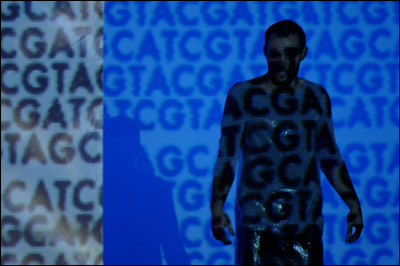
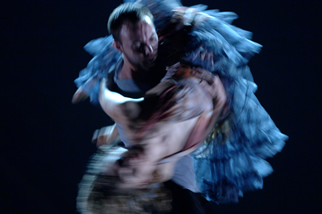
Ms. TATA is just one of the characters populating Liz Lerman Dance Exchange's multimedia "Ferocious Beauty: Genome," the end-product of a multi-year collaboration with over 30 scientists aiming to interpret genetics through dance.The dancers' intersection with science begins in a scene from a "laboratory," where they spiral like the DNA helix, relate in groups of three like codons, and "fly" like Drosophila. In a wry wink, the dancers unzip their costumes -- like DNA, get it? -- to reveal messages written on their bodies, such as "Knowledge is a Blessing." The choreography hits an evocative moment with the story of Mendel and his peas. The black-robed Mendel, portrayed by dancer Ted Johnson, winds his way around the stage, while a video shows Johnson, also as Mendel, tending, counting, and sorting peas. Johnson's winding evokes the sweet peas' growth and the as-yet mysterious structure of the DNA helix. The video switches to images of scientists offering what they would like to tell Mendel. Wesleyan University biochemist Manju Hingorani, who worked with Lerman to develop the program, asks, "Would you like to see a gene? Because it's beautiful."
On the screen, the images of Mendel's peas are slowly overwritten by the names of important geneticists scrolling past in white. First, Mendel and Darwin. Then, Garrod, Beadle, Tatum, etc. As time goes on, more and more names scroll by, the pace gets furious, and the screen eventually whites out from the sheer number of people currently studying the genome. One scene shows another video of researchers describing how they would choreograph DNA. One imagines laying the dancers head to toe, head to toe, head to toe, while on stage, dancers wend around each other as they portray genes undergoing various rounds of shuffling and translocations while maintaining the head to toe orientation. Lerman, a 2002 MacArthur Fellow, and her company relied on the input of top geneticists including Princeton's Bonnie Bassler, Columbia's Nancy Wexler, and Richard Mural from Celera Genomics. And audience members appreciate their voices in the piece, she says -- one of the most common comments she receives is how impressive, passionate and creative the scientists are.
The performance also captures the importance of genetic variability. Suzanne Richard, a dancer who uses a wheelchair and crutches as a result of the genetic disorder osteogenesis imperfecta, gracefully moves from wheelchair to crutches and back while dancing with the rest of the company. "We need to be sensitive to honoring and valuing the differences between people. Without that variation, we wouldn't be able to do genetics," noted Irene Eckstrand, a National Institutes of Health scientist who participated in the project and an after-performance panel discussion.Ferocious Beauty demonstrates and celebrates the human drive to create, whether in science or the arts."When we are truly doing something new, we have no words for it, all we have are our metaphors for what we are observing, and that is the same creative process dancers experience as they work to find a way to express an abstract idea in movement," Richard Mural said during the panel discussion. "And when you get it, no one can take the satisfaction of that from you."Ferocious Beauty: Genome will reprise September 27-29 in Toronto, after which it will tour to Tempe, Arizona.Lisa Seachrist Chiu mail@the-scientist.comImages: From Ferocious Beauty: Genome, taken by Kevin Kennefick. Clarification (Posted May 5): When originally posted, the article contained incomplete information for upcoming dates in Toronto. Links within this article:D. Secko, "Computing gene regulation," The Scientist, June 21, 2004. http://www.the-scientist.com/article/display/14772Ferocious Beauty: Genome http://www.danceexchange.org/performance/ferociousbeautygenome.htmlVK McElheny, "The human genome project + 5," The Scientist, February 2006. http://www.the-scientist.com/2006/2/1/42/1Manju Hingorani http://www.wesleyan.edu/molbiophys/Faculty/Hingorani/hingorani.cv.htmN. Atkinson, "The reduction of seduction," The Scientist, September 1, 2006. http://www.the-scientist.com/article/display/24522/K. Hopkin, "How bacteria talk," The Scientist, June 2006. http://www.the-scientist.com/article/display/23546/Nancy Wexler http://www.hdfoundation.org/bios/nancyw.phpJ. Perkel, "Osteogenesis imperfecta gene identified," The Scientist, October 19, 2006. http://www.the-scientist.com/news/display/25107/Irene Eckstrand http://www.nigms.nih.gov/About/Eckstrand.htm
Interested in reading more?

Become a Member of

The Scientist Logo
Receive full access to more than 35 years of archives, as well as TS Digest, digital editions of The Scientist, feature stories, and much more!
Already a member? Login Here

Meet the Author

Share
Image of a woman with her hands across her stomach. She has a look of discomfort on her face. There is a blown up image of her stomach next to her and it has colorful butterflies and gut bacteria all swarming within the gut.
November 2025, Issue 1

Why Do We Feel Butterflies in the Stomach?

These fluttering sensations are the brain’s reaction to certain emotions, which can be amplified or soothed by the gut’s own “bugs".

View this Issue
Olga Anczukow and Ryan Englander discuss how transcriptome splicing affects immune system function in lung cancer.

Long-Read RNA Sequencing Reveals a Regulatory Role for Splicing in Immunotherapy Responses

Pacific Biosciences logo
Research Roundtable: The Evolving World of Spatial Biology

Research Roundtable: The Evolving World of Spatial Biology

Conceptual cartoon image of gene editing technology

Exploring the State of the Art in Gene Editing Techniques

Bio-Rad
Conceptual image of a doctor holding a brain puzzle, representing Alzheimer's disease diagnosis.

Simplifying Early Alzheimer’s Disease Diagnosis with Blood Testing

fujirebio logo

Products

Eppendorf Logo

Research on rewiring neural circuit in fruit flies wins 2025 Eppendorf & Science Prize

Evident Logo

EVIDENT's New FLUOVIEW FV5000 Redefines the Boundaries of Confocal and Multiphoton Imaging

Evident Logo

EVIDENT Launches Sixth Annual Image of the Year Contest

10x Genomics Logo

10x Genomics Launches the Next Generation of Chromium Flex to Empower Scientists to Massively Scale Single Cell Research