A Greener Arctic

Algal blooms are appearing under the ice in the Arctic Ocean in areas thought to receive too little light to support photosynthetic life.

Written byEdyta Zielinska
| 1 min read

Register for free to listen to this article
Listen with Speechify
0:00
1:00
Share

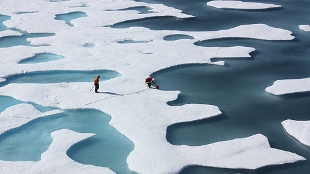
Ice ponds in the Arctic OceanNASA, KATHRYN HANSEN

Phytoplankton blooms are expected in the summer after the ice melts in the Artic, in open waters that are free of ice. But in a paper published in Science last week (June 7), scientists observed that these blooms are occurring much earlier, in areas where the ice has thinned over the years, allowing light to penetrate.

The researchers noticed accumulated pools of water that had melted on the surface of the frozen Chukchi Sea, located between Alaska and Siberia. The researchers sampled the waters beneath the meter-thick ice and found a bloom that extended over 100 kilometers.

Because the blooms are occurring earlier in the season than expected, migratory birds and whales that come to the nutrient-rich waters to feed could be affected, though it's ...

Interested in reading more?

Become a Member of

The Scientist Logo
Receive full access to more than 35 years of archives, as well as TS Digest, digital editions of The Scientist, feature stories, and much more!
Already a member? Login Here

Related Topics

Meet the Author

Share
Illustration of a developing fetus surrounded by a clear fluid with a subtle yellow tinge, representing amniotic fluid.
January 2026, Issue 1

What Is the Amniotic Fluid Composed of?

The liquid world of fetal development provides a rich source of nutrition and protection tailored to meet the needs of the growing fetus.

View this Issue
Redefining Immunology Through Advanced Technologies

Redefining Immunology Through Advanced Technologies

Ensuring Regulatory Compliance in AAV Manufacturing with Analytical Ultracentrifugation

Ensuring Regulatory Compliance in AAV Manufacturing with Analytical Ultracentrifugation

Beckman Coulter Logo
Skip the Wait for Protein Stability Data with Aunty

Skip the Wait for Protein Stability Data with Aunty

Unchained Labs
Graphic of three DNA helices in various colors

An Automated DNA-to-Data Framework for Production-Scale Sequencing

illumina

Products

nuclera logo

Nuclera eProtein Discovery System installed at leading Universities in Taiwan

Brandtech Logo

BRANDTECH Scientific Introduces the Transferpette® pro Micropipette: A New Twist on Comfort and Control

Biotium Logo

Biotium Launches GlycoLiner™ Cell Surface Glycoprotein Labeling Kits for Rapid and Selective Cell Surface Imaging

Colorful abstract spiral dot pattern on a black background

Thermo Scientific X and S Series General Purpose Centrifuges

Thermo Fisher Logo










