


 A SpaceX Falcon 9 rocket lifted off from NASA’s Kennedy Space Center in Florida on June 3, carrying the Dragon resupply spacecraft on SpaceX’s eleventh Commercial Resupply Services mission to the International Space Station.FLICKR, SPACEXLast month, more than 4,000 fruit fly eggs and adults began the summer vacation of their short lives. Riding in vials inside six tissue box–size containers, the flies were loaded onto a SpaceX Dragon spacecraft and launched out of the Earth’s atmosphere, headed for the International Space Station (ISS). They spent a month orbiting Earth before returning in the Dragon and splashing down into the Pacific Ocean off the coast of Baja California, Mexico, where they were collected by barge and rushed to the lab of Karen Ocorr at Sanford Burnham Prebys Medical Discovery Institute (SBP) in San Diego, California.
“Imagine dissecting 4,000 flies over [a few] days,” Ocorr tells The Scientist. In addition to dissecting plenty of flies herself, she coordinated the work of up to 20 people working 12–18 hour days to process the insects after their return. “We’ll be swimming in data for the next couple of months, and we also we had them lay eggs [before we sacrificed them], so that we can look at the next generation,” she adds.
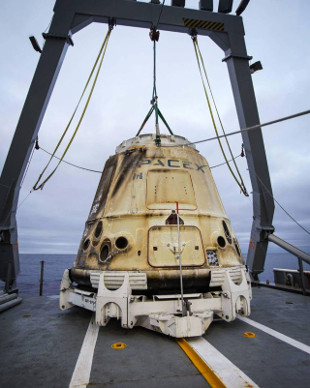 The SpaceX Dragon cargo craft splashed down in the Pacific Ocean on the morning of July 3.NASA, SPACEXThe researchers face three more long weeks of data collection from the control flies and the progeny of the returned flies, not to mention the time and effort necessary to make sense of it all. But the labor and cost—about $40,000 per box of flies just to send them into space and bring them back—are worth it for Ocorr and her collaborators at SBP and the NASA Ames Research Center. The goal of the project, called Fruit Fly Lab-02, is to study the effects of microgravity on fly cardiac development, gene expression, and function.
“The fruit fly heart is remarkably similar in many respects to the human heart,” says Ocorr. Fruit flies also have the advantage of being small—essential for ...












