Bee College

Beekeepers gather at the University of Florida this weekend to learn tricks of the trade

Written byMegan Scudellari
| 2 min read

Register for free to listen to this article
Listen with Speechify
0:00
2:00
Share
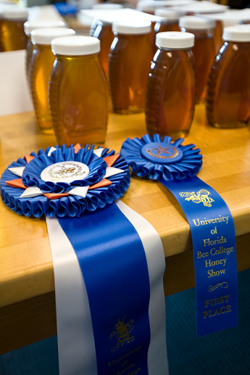
People are buzzing about this year's linkurl:Bee College,;http://entnemdept.ifas.ufl.edu/honeybee/extension/bee_college.shtml an annual event hosted by the University of Florida (UF) for beekeepers and bee enthusiasts. This year, more than 300 participants will gather on the Florida coast to learn to build an apiary, dissect a bee, watch an open hive demonstration, and, of course, taste some honey.
Tyler Jones, UF/IFAS
"It's for beekeepers at any level, from beginning beekeepers up to commercial beekeepers with thousands of hives," says linkurl:Jason Graham,;http://entnemdept.ufl.edu/honeybee/Jason%20page.html an entomology doctoral student at UF who will be leading two workshops at the event. The event is held at the university's Whitney Laboratory for Marine Bioscience. Organizers expect attendance at this year's event to be more than double that of the first Bee College, held in 2008. Friday kicks off with the linkurl:Master Beekeeper Program,;http://entnemdept.ifas.ufl.edu/honeybee/extension/master_beekeeper.shtml a certificate program (including exams) for Florida beekeepers at all levels, and -- back by popular demand -- the African Bee Pest Management Training for Pest Control Operators. And little ones aren't forgotten: a Jr. Bee College will teach children ages six to sixteen the wonders of the important pollinators.
Demonstration at 2010 Bee College
Tyler Jones, UF/IFAS
Throughout the weekend experts will hold numerous workshops, and speakers will deliver a variety of bee-related talks, including a lecture on bee evolution, a 3-D presentation on honey bee anatomy, an overview of pests and diseases, and even a session on candles and other wax products.This year's Bee College will emphasize the cultivation of native bees -- which means "anything other than a European honeybee," according to Graham. linkurl:Glenn Hall,;http://entnemdept.ufl.edu/hg_hall.htm a UF entomologist, will present an overview of Florida's native bee families, two other UF staffers will lead a workshop on enhancing a garden to attract native bees, and Graham will teach attendees to build native bee nests from lumber and bamboo. "These are artificial nest sites that someone can put in their backyard and encourage some of the solitary, native bees to move in and help out with pollination." A perk of raising native, solitary bees -- which live alone, rather than in large hives like honey bees -- is that they don't have the same alarm pheromones and defenses as honeybees, so you'll only get stung if you "grab one and hold it," says Graham. "I've learned from experience."
UF Honey Bee Research and Extension Laboratory
Last but not least, participants are encouraged to bring a few of their own bees in a jar for a bee dissection class, and to enter honey or bee art into the 4th Annual Bee College Honey Show, in which entrants can submit their sweet product in the amber, dark, creamed honey and beeswax cake categories, among others.
**__Related stories and F1000 evaluations:__***linkurl:Research at recess;http://www.the-scientist.com/news/display/57967/
[28th January 2011] *linkurl:The honey bee epigenomes;http://f1000.com/7259956?key=jb2q5287qqb7byj
[29th December 2010] *linkurl:Bee calamity clarified;http://www.the-scientist.com/blog/display/55919/
[24th August 2009]
Interested in reading more?

Become a Member of

The Scientist Logo
Receive full access to more than 35 years of archives, as well as TS Digest, digital editions of The Scientist, feature stories, and much more!
Already a member? Login Here

Meet the Author

Share
December digest cover image of a wooden sculpture comprised of multiple wooden neurons that form a seahorse.
December 2025, Issue 1

Wooden Neurons: An Artistic Vision of the Brain

A neurobiologist, who loves the morphology of cells, turns these shapes into works of art made from wood.

View this Issue
Stacks of cell culture dishes, plates, and flasks with pink cell culture medium on a white background.

Driving Innovation with Cell Culture Essentials

Merck
Stacks of cell culture dishes, plates, and flasks with pink cell culture medium on a white background.

Driving Innovation with Cell Culture Essentials

MilliporeSigma purple logo
Human iPSC-derived Models for Brain Disease Research

Human iPSC-derived Models for Neurodegenerative Disease Research

Fujifilm
Abstract wireframe sphere with colorful dots and connecting lines representing the complex cellular and molecular interactions within the tumor microenvironment.

Exploring the Inflammatory Tumor Microenvironment 

Cellecta logo

Products

brandtech logo

BRANDTECH® Scientific Announces Strategic Partnership with Copia Scientific to Strengthen Sales and Service of the BRAND® Liquid Handling Station (LHS) 

Top Innovations 2026 Contest Image

Enter Our 2026 Top Innovations Contest

Biotium Logo

Biotium Expands Tyramide Signal Amplification Portfolio with Brighter and More Stable Dyes for Enhanced Spatial Imaging

Labvantage Logo

LabVantage Solutions Awarded $22.3 Million U.S Customs and Border Protection Contract to Deliver Next-Generation Forensic LIMS