BP Denies Full Blame

The oil company tells a US court that it is not solely responsible for the 2010 Deepwater Horizon disaster.

Written byJef Akst
| 1 min read

Register for free to listen to this article
Listen with Speechify
0:00
1:00
Share

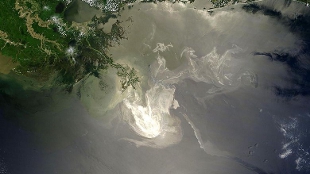
Sunlight illuminates the lingering oil slick off the Mississippi Delta on May 24, 2010.WIKIMEDIA, NASA/GSFC, MODIS RAPID RESPONSEIn a liability trial for the 2010 oil spill that killed 11 men and released some 4 million barrels of oil the Gulf of Mexico, a senior BP executive Lamar McKay argues that his company was not the only guilty party in the disaster; Transocean, which owned and operated ran the Deepwater Horizon rig, and contractor Halliburton, which provided the cement used to seal the Macondo well, are also partly responsible.

“I think that's a shared responsibility, to manage the safety and the risk,”' McKay told the court, according to BBC News. “Sometimes contractors manage that risk. Sometimes we do. Most of the time it’s a team effort.”

Robert Bea, an engineering professor at the University of California, Berkeley, and a former BP safety expert, testified on the US Department of Justice and the affected US states, the trial plaintiffs, stating that BP was directly responsible; that the spill was a result of the company’s poor management and heavy cost-cutting. “It's a classic failure of management and leadership in BP,” he testified.

BP paid $4.5 billion in 2012 to settle criminal charges and $7.8 billion to affected families and businesses, and now faces additional fines—up to ...

Interested in reading more?

Become a Member of

The Scientist Logo
Receive full access to more than 35 years of archives, as well as TS Digest, digital editions of The Scientist, feature stories, and much more!
Already a member? Login Here

Related Topics

Meet the Author

  • Jef (an unusual nickname for Jennifer) got her master’s degree from Indiana University in April 2009 studying the mating behavior of seahorses. After four years of diving off the Gulf Coast of Tampa and performing behavioral experiments at the Tennessee Aquarium in Chattanooga, she left research to pursue a career in science writing. As The Scientist's managing editor, Jef edited features and oversaw the production of the TS Digest and quarterly print magazine. In 2022, her feature on uterus transplantation earned first place in the trade category of the Awards for Excellence in Health Care Journalism. She is a member of the National Association of Science Writers.

    View Full Profile
Share
Illustration of a developing fetus surrounded by a clear fluid with a subtle yellow tinge, representing amniotic fluid.
January 2026

What Is the Amniotic Fluid Composed of?

The liquid world of fetal development provides a rich source of nutrition and protection tailored to meet the needs of the growing fetus.

View this Issue
Human-Relevant In Vitro Models Enable Predictive Drug Discovery

Advancing Drug Discovery with Complex Human In Vitro Models

Stemcell Technologies
Redefining Immunology Through Advanced Technologies

Redefining Immunology Through Advanced Technologies

Ensuring Regulatory Compliance in AAV Manufacturing with Analytical Ultracentrifugation

Ensuring Regulatory Compliance in AAV Manufacturing with Analytical Ultracentrifugation

Beckman Coulter Logo
Conceptual multicolored vector image of cancer research, depicting various biomedical approaches to cancer therapy

Maximizing Cancer Research Model Systems

bioxcell

Products

Refeyn logo

Refeyn named in the Sunday Times 100 Tech list of the UK’s fastest-growing technology companies

Parse Logo

Parse Biosciences and Graph Therapeutics Partner to Build Large Functional Immune Perturbation Atlas

Sino Biological Logo

Sino Biological's Launch of SwiftFluo® TR-FRET Kits Pioneers a New Era in High-Throughout Kinase Inhibitor Screening

SPT Labtech Logo

SPT Labtech enables automated Twist Bioscience NGS library preparation workflows on SPT's firefly platform