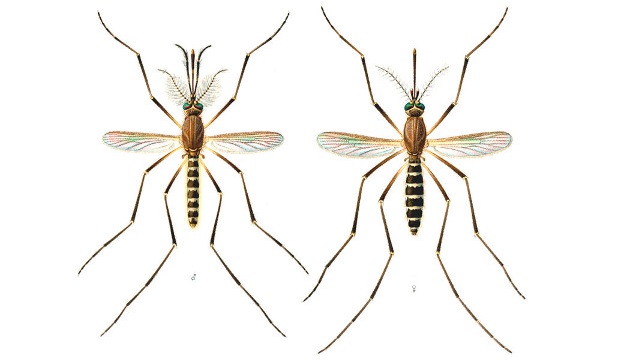
 WIKIMEDIAAt the International Congress of Entomology’s annual meeting held in Orlando, Florida, this week, separate labs presented unpublished data suggesting that Culex mosquitoes can harbor the Zika virus, Science News reported. Scientists at the Oswaldo Cruz Foundation in Recife, Brazil, and at Brock University in Ontario, Canada, shared their independent identification of Zika in the guts and saliva of Culex species.
As Science News noted, “Even if the mosquitoes prove competent at passing along Zika, there remain questions of whether their tastes, behavior, and ecology will lead them to actually do so.”
Whether these insects are Zika virus vectors remains a matter of debate. Last month, researchers at Kansas State University published evidence to suggest that Culex species commonly found in parts of the U.S. are somewhat resistant to the virus. “The evidence has demonstrated that neither C. pipiens nor C. quinquefasciatus, which are widely distributed and referred to as northern and southern house mosquitoes, respectively, can serve as competent vector species for transmission of ZIKV [Zika virus],” the authors wrote in Vector-Borne and Zoonotic Diseases.
Separately, scientists at the University of Texas Medical Branch (UTMB) ...