bio-rad-chemidoc-go-1800x720
Product

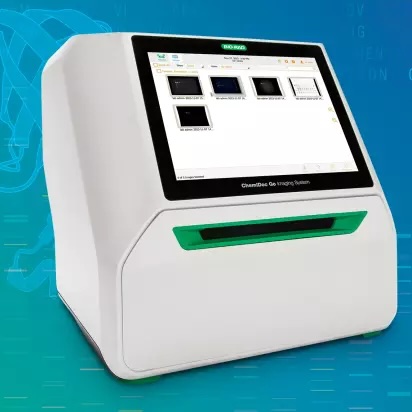
ChemiDoc Go Imaging System ​

The next generation imager from the ChemiDoc Imaging System line. Effortlessly capture gel and western blot images from your benchtop without compromising on sensitivity and precision.

Share

ChemiDoc Go

Capture gel and western blot images from your benchtop with the same sensitivity as larger, shared instruments. With advanced scientific CMOS digital imaging, expect no compromises in sensitivity or useful linear range when using the ChemiDoc Go Imaging System. Choose traditional chemiluminescent detection, colorimetric, or use cost-effective fluorescent StarBright™ Blue antibodies and go further with multiplex analysis. Normalize to total protein and eliminate the need to detect housekeeping proteins using Stain-Free Gels in your western blot workflow.

Product Specifications:

Smart Tray Technology The ChemiDoc Go Imaging System automatically recognizes your application-specific tray and adjusts imaging parameters and software options accordingly
Auto-focus Precalibrated focus for any zoom setting
Auto-exposureTwo auto-exposure algorithms (rapid or optimal)
Image flat fielding Dynamic; precalibrated and optimized for every application
Touch Screen FunctionalityMultitouch capable Display resolution 1,024 x 768 pixels 9.7" (24.64 cm) display
Maximum image area (W x H)21 x 14 cm
Detector 20.48 MP BSI (back-side illuminated) CMOS
Bit depth65,536
Quantum Efficiency75% at 425 nm
Instrument size (W x D x H) 36 cm x 48 cm x 36 cm

Sponsored by

  • Bio-Rad
Image of a woman with her hands across her stomach. She has a look of discomfort on her face. There is a blown up image of her stomach next to her and it has colorful butterflies and gut bacteria all swarming within the gut.
November 2025, Issue 1

Why Do We Feel Butterflies in the Stomach?

These fluttering sensations are the brain’s reaction to certain emotions, which can be amplified or soothed by the gut’s own “bugs".

View this Issue
Golden geometric pattern on a blue background, symbolizing the precision, consistency, and technique essential to effective pipetting.

Best Practices for Precise Pipetting

Integra Logo
Olga Anczukow and Ryan Englander discuss how transcriptome splicing affects immune system function in lung cancer.

Long-Read RNA Sequencing Reveals a Regulatory Role for Splicing in Immunotherapy Responses

Pacific Biosciences logo
Research Roundtable: The Evolving World of Spatial Biology

Research Roundtable: The Evolving World of Spatial Biology

Conceptual cartoon image of gene editing technology

Exploring the State of the Art in Gene Editing Techniques

Bio-Rad

Products

Labvantage Logo

LabVantage Solutions Awarded $22.3 Million U.S Customs and Border Protection Contract to Deliver Next-Generation Forensic LIMS

The Scientist Placeholder Image

Evosep Unveils Open Innovation Initiative to Expand Standardization in Proteomics

OGT logo

OGT expands MRD detection capabilities with new SureSeq Myeloid MRD Plus NGS Panel







