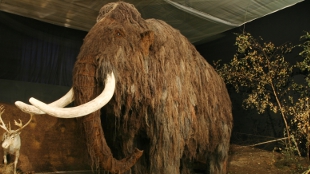
Dwarf Mammoth Once Roamed Crete

Researchers analyze a diminutive forelimb bone, calling it conclusive evidence that a tiny mammoth resided on the Greek island.

Written byBob Grant
| 1 min read

Register for free to listen to this article
Listen with Speechify
0:00
1:00
Share

Think mammoth, only smallerWIKIMEDIA COMMONS, PETR NOVAK

A mammoth that stood only 1 meter tall and weighed in at 300 kilograms used to call the small Mediterranean Island of Crete home, according to scientists at London's Natural History Museum. Researchers had previously unearthed what they thought were fossil elephant teeth on Crete, but the discoveries last year of another molar—with structural characteristics of mammoths—and a small humerous on the island suggested a mammoth species that appeared to be struck by island dwarfism, where island-bound species evolve to have smaller stature. "This creature would look like a baby Asian elephant, only chunkier and with curvy tusks," Victoria Herridge, paleontologist and first author of the Proceedings of the Royal Society B paper reporting the findings, told Nature.

Herridge and her coauthor Adrian Lister dubbed ...

Interested in reading more?

Become a Member of

The Scientist Logo
Receive full access to more than 35 years of archives, as well as TS Digest, digital editions of The Scientist, feature stories, and much more!
Already a member? Login Here

Related Topics

Meet the Author

  • From 2017 to 2022, Bob Grant was Editor in Chief of The Scientist, where he started in 2007 as a Staff Writer. Before joining the team, he worked as a reporter at Audubon and earned a master’s degree in science journalism from New York University. In his previous life, he pursued a career in science, getting a bachelor’s degree in wildlife biology from Montana State University and a master’s degree in marine biology from the College of Charleston in South Carolina. Bob edited Reading Frames and other sections of the magazine.

    View Full Profile
Share
Illustration of a developing fetus surrounded by a clear fluid with a subtle yellow tinge, representing amniotic fluid.
January 2026

What Is the Amniotic Fluid Composed of?

The liquid world of fetal development provides a rich source of nutrition and protection tailored to meet the needs of the growing fetus.

View this Issue
Human-Relevant In Vitro Models Enable Predictive Drug Discovery

Advancing Drug Discovery with Complex Human In Vitro Models

Stemcell Technologies
Redefining Immunology Through Advanced Technologies

Redefining Immunology Through Advanced Technologies

Ensuring Regulatory Compliance in AAV Manufacturing with Analytical Ultracentrifugation

Ensuring Regulatory Compliance in AAV Manufacturing with Analytical Ultracentrifugation

Beckman Coulter Logo
Conceptual multicolored vector image of cancer research, depicting various biomedical approaches to cancer therapy

Maximizing Cancer Research Model Systems

bioxcell

Products

Refeyn logo

Refeyn named in the Sunday Times 100 Tech list of the UK’s fastest-growing technology companies

Parse Logo

Parse Biosciences and Graph Therapeutics Partner to Build Large Functional Immune Perturbation Atlas

Sino Biological Logo

Sino Biological's Launch of SwiftFluo® TR-FRET Kits Pioneers a New Era in High-Throughout Kinase Inhibitor Screening

SPT Labtech Logo

SPT Labtech enables automated Twist Bioscience NGS library preparation workflows on SPT's firefly platform