


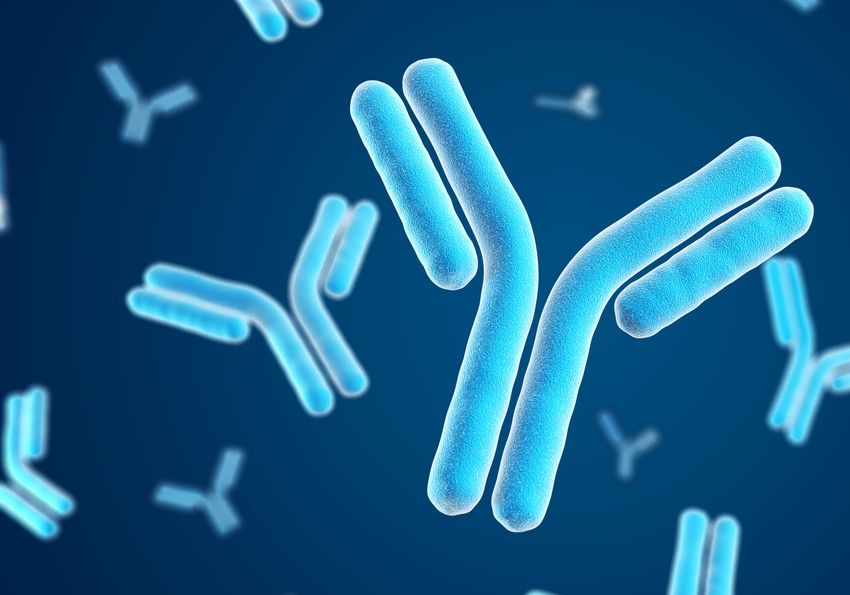
Whether produced via hybridoma or recombinant DNA technology, monoclonal antibodies are fundamental to scientific research.
©iStock, bodym
In 1985, muromonab, indicated for the treatment of transplant rejection, became the first therapeutic monoclonal antibody licensed for marketing. Much of the credit lies with César Milstein and Georges Köhler, who were the first to create an immortal hybridoma cell line that produced immunoglobulins with an identical amino acid sequence.1 Other groups soon built on their findings and began to create antibodies using recombinant DNA techniques. Since then, monoclonal antibodies have become fundamental to scientific research, and scientists in numerous fields now rely on timely access to high-quality, reliable antibodies.
How Are Monoclonal Antibodies Made?
Researchers still use hybridomas to generate monoclonal antibodies, and the overall technique has remained essentially the same. First, the experimental team immunizes an animal with the antigen of choice. After the animal develops antibodies, scientists isolate B lymphocytes, fuse them to a myeloma cell line, and perform a dilution to separate out individual hybridomas.2 Alternatively, monoclonal antibodies may be produced using recombinant technology, where researchers clone the genetic sequence encoding a particular antibody into a vector and then transfect that into a mammalian cell line, such as HEK293. Often, scientists use these two methods to complement each other, sequencing an antibody originally generated using hybridoma technology and converting it to recombinant production to ensure a long-term, reproducible supply of antibody.3
Monoclonal Antibodies: An Experimental MVP
Whether produced via hybridoma or recombinant DNA technology, monoclonal antibodies are fundamental to a range of experimental techniques. They serve important roles in imaging and detection assays, while functional applications such as neutralization, activation, or depletion extend their utility to disease modeling, immune mechanism studies, and therapeutic evaluation. However, monoclonal antibody production requires deep expertise, and many commercially available antibodies are extremely expensive or only available in small quantities.2-4 Some also contain contaminants such as endotoxins, protein aggregates, or preservatives, which may trigger immune reactions and compromise experimental results. In addition, a number of research applications require conjugated antibodies specifically tailored for the scientist’s intended downstream use. These challenges make many antibody formulations unsuitable for in vivo assays, and the obstacles that scientists encounter when looking for appropriate antibodies can slow down critical research projects or halt them altogether.4
Scalable, High-Quality Antibody Manufacturing Is Key for Scientific Success
Scientists can circumvent these challenges and keep their research moving forward with Bio X Cell’s in vivo antibodies, which are formulated in preservative-free PBS, tested for pathogens and aggregation, and guaranteed to have ultra-low levels of endotoxins.4 Bio X Cell ensures reproducibility in preclinical models through rigorous production standards that minimize immunogenicity and off-target effects. The antibodies offered are backed by strong citation histories and validated for in vivo functionality, including neutralization, activation, and depletion. For specialized needs, Bio X Cell also provides customization options such as conjugation, tailored production services, and antibody sourcing, all supported by decades of manufacturing expertise.
These capabilities directly impacted Aron Lukacher’s research at Pennsylvania State University, where Bio X Cell delivered a hard-to-source antibody that advanced critical in vivo experiments.4
Lukacher’s research group studies polyomavirus infections, which can be dangerous for kidney transplant recipients. Kidney-infiltrating T cells can prevent viral reactivation, and his team found that T cell recruitment and maintenance was driven by CXCR6-CXCL16 signaling.5 The scientists needed to block this pathway in mice over multiple timepoints, but the commercially available CXCL16-neutralizing antibodies were either prohibitively expensive, contained stabilizers or endotoxins inappropriate for in vivo work, or could not be purchased at high enough volumes for animal injections.
Through its custom antibody production services, Bio X Cell sourced the original hybridoma and produced large volumes of antibody in-house. The antibody’s purity and blocking activity, ensured by Bio X Cell’s in vivo-grade standards, enabled Lukacher’s group to confirm their hypothesis and progress research relevant to kidney transplant recipients.4,5
Inconsistent or impure antibodies can delay projects and complicate data interpretation, while timely access to high-quality, large-scale production is critical for keeping research moving forward. Bio X Cell’s rigorous quality standards and robust, scalable in-house manufacturing make it an ideal scientific partner, facilitating the complex in vivo experiments that lead to scientific breakthroughs.
- Marks L. The birth pangs of monoclonal antibody therapeutics. mAbs. 2012;4(3):403-412.
- Holzlöhner P and Hanack K. Generation of murine monoclonal antibodies by hybridoma technology. J Vis Exp. 2017;119: e54832.
- DeLuca KF, et al. Production and purification of recombinant monoclonal antibodies from human cells based on a primary sequence. Star Protoc. 2022;3(4):101915.
- Bushey K. Solving the antibody access problem in translational research with custom services. BioXCell. 2025.
- Lauver MD, et al. The CXCR6-CXCL16 axis mediates T cell control of a polyomavirus infection in the kidney. PLoS Pathog. 2025;21(3): e1012969.











