Old ovaries, new eggs

Are female mammals born with all the eggs they'll ever have, or can they produce new eggs into adulthood? The question has been vociferously debated, but now, a study published online in Nature Cell Biology today (April 12) reports that at least in mice, adult female ovaries have a store of stem cells that have the potential to generate new eggs. Human oocyte Image: Wikimedia CommonsThe study "is a huge step in quelling this debate," Jonathan Tilly, a reproductive biologist at Harvard Medical

Written byTia Ghose
| 2 min read

Register for free to listen to this article
Listen with Speechify
0:00
2:00
Share
Are female mammals born with all the eggs they'll ever have, or can they produce new eggs into adulthood? The question has been vociferously debated, but now, a study published online in Nature Cell Biology today (April 12) reports that at least in mice, adult female ovaries have a store of stem cells that have the potential to generate new eggs.
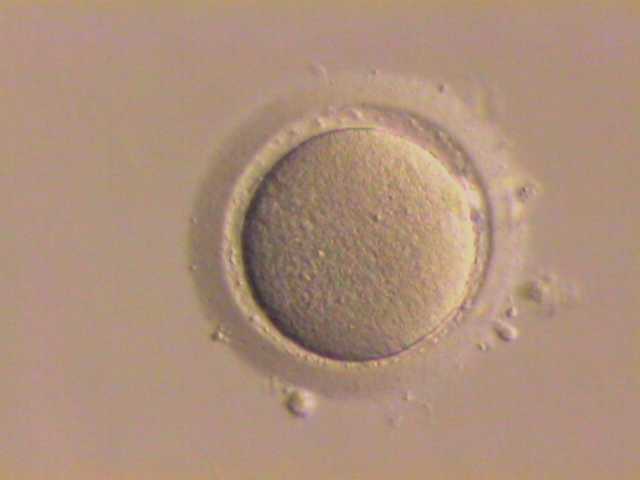
Human oocyte
Image: Wikimedia Commons
The study "is a huge step in quelling this debate," Jonathan Tilly, a reproductive biologist at Harvard Medical School, told The Scientist. "You're starting to look at a body of evidence that you simply can't refute anymore." The idea that mammals stop forming new eggs at birth has held sway since the 1950's, but in 2004, Tilly and his colleagues published a paper in Nature claiming they had found germ line stem cells--those responsible for forming new sex cells like sperm and oocytes--in the mouse ovary. The findings raised the possibility that female adult mammals may be able to produce new eggs. Other groups have also found evidence for the existence of functional germ cells in adult ovaries, but some scientists have disputed these findings based on their statistical methods and estimations of how many immature eggs are reabsorbed by the body, said Tilly. Ji Wu at Shanghai Jiao Tong University in China, and colleagues attempted to resolve the issue with a simple transplantation experiment. First, they identified candidate stem cells by testing ovarian tissue for mouse vasa homologue (MVH), a hormone exclusively found in germ cells. Next, they fluorescently tagged the MVH-containing cells, extracted them, and cultured them. They then implanted the cells from adult mice into the ovaries of mice whose eggs had been chemically destroyed. Mice with the implanted cells formed new eggs and went on to have healthy pups from those eggs. Though the experimental results are "fantastic," they don't show that adult mammals actually form eggs as part of their natural life cycle, cautioned Evelyn Telfer, a reproductive biologist at the University of Edinburgh in Scotland. Indeed, the cell culture process can "definitely change the developmental potential of cells," so the cells they implanted could be fundamentally different from those that spent all their time in a mouse, said Amy Wagers, a stem cell biologist at Harvard University and the Joslin Diabetes Center in Boston. Tilly agreed. "There's no evidence put forward that these cells, during normal function of the adult ovary, contribute new oocytes," he said. However, it does show that adults can grow new eggs in certain circumstances. Tilly's group is currently doing experiments to see whether adult mammals regularly grow new eggs. Most evidence still suggests females do not routinely form new eggs in adulthood, Telfer said. For instance, chemotherapy often destroys a woman's eggs, yet after treatment women are infertile--presumably because their ovaries are not able to generate new eggs. And what's true for mice may not hold for humans: To see whether similar germ line stem cells exist in humans, researchers would need to investigate human ovary tissue, she said. If the germ cells are present in humans, they could eventually be used to develop treatments that allow women to produce new eggs after theirs have been destroyed or damaged, Tilly said.
**__Related stories:__***linkurl:New eggs from old mice?;http://www.the-scientist.com/article/display/53228/
[1st June 2007]*linkurl:No mature eggs from bone marrow;http://www.the-scientist.com/news/display/23653/
[15th June 2006]*linkurl:New oocytes from bone marrow?;http://www.the-scientist.com/article/display/22742/
[28th July 2005]
Interested in reading more?

Become a Member of

The Scientist Logo
Receive full access to more than 35 years of archives, as well as TS Digest, digital editions of The Scientist, feature stories, and much more!
Already a member? Login Here

Meet the Author

Share
Image of a man in a laboratory looking frustrated with his failed experiment.
February 2026

A Stubborn Gene, a Failed Experiment, and a New Path

When experiments refuse to cooperate, you try again and again. For Rafael Najmanovich, the setbacks ultimately pushed him in a new direction.

View this Issue
Human-Relevant In Vitro Models Enable Predictive Drug Discovery

Advancing Drug Discovery with Complex Human In Vitro Models

Stemcell Technologies
Redefining Immunology Through Advanced Technologies

Redefining Immunology Through Advanced Technologies

Ensuring Regulatory Compliance in AAV Manufacturing with Analytical Ultracentrifugation

Ensuring Regulatory Compliance in AAV Manufacturing with Analytical Ultracentrifugation

Beckman Coulter Logo
Conceptual multicolored vector image of cancer research, depicting various biomedical approaches to cancer therapy

Maximizing Cancer Research Model Systems

bioxcell

Products

Sino Biological Logo

Sino Biological Pioneers Life Sciences Innovation with High-Quality Bioreagents on Inside Business Today with Bill and Guiliana Rancic

Sino Biological Logo

Sino Biological Expands Research Reagent Portfolio to Support Global Nipah Virus Vaccine and Diagnostic Development

Beckman Coulter

Beckman Coulter Life Sciences Partners with Automata to Accelerate AI-Ready Laboratory Automation

Refeyn logo

Refeyn named in the Sunday Times 100 Tech list of the UK’s fastest-growing technology companies











