


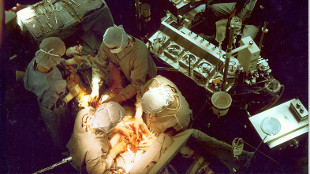
 Wikimedia, NIHSurgeons at the New Cross Hospital in Wolverhampton, United Kingdom, performed the country’s first robotic-assisted heart surgeries using a $1.6 million remote-controlled robot, called Da Vinci, according to a news story published yesterday (October 22) by the BBC. In one of the robot-assisted surgeries, a young woman, Natalie Jones of Stourbridge, had a 1.3-inch hole repaired in her heart. In a second surgery, the robot repaired the valve between the left atrium and ventricle of a middle-aged man, Paul Whitehouse from Halesowen.
Finland and Sweden are the only other countries in Europe to perform robotic heart surgery, while surgeons in America performed their first robot-assisted heart surgery in 1999.
While conventional heart surgery requires opening the whole breastplate, surgery using Da Vinci requires only incisions between the ribs, and doctors say the surgery over-all is safer and the patients recover faster. “There is less pain and patients are able to return home to their normal activities far sooner,” heart surgeon Stephen Billing, who was involved in both surgeries, told the BBC. The remote-controlled robot can make precise motions—moving just 1 mm for every 3 mm that the doctors move their hands—and surgeons have a 3-dimensional view of a patient’s heart throughout the procedure.
But, robotic surgery comes ...












