Silenced genes drive viral cancers?

Epigenetic changes in certain viruses can make the difference between a simple infection and cancer, according to a new study published early online tomorrow (Feb 10th) in __Genome Research.__ linkurl:Stephan Beck,;http://www.ucl.ac.uk/cancer/research-groups/medical-genomics/ a medical genomicist at University College London who was not involved in the research, said he was "excited" by the findings, which identify "the correlation between cancer progression and methylation." Researchers have

Written byEdyta Zielinska
| 2 min read

Register for free to listen to this article
Listen with Speechify
0:00
2:00
Share
Epigenetic changes in certain viruses can make the difference between a simple infection and cancer, according to a new study published early online tomorrow (Feb 10th) in __Genome Research.__ linkurl:Stephan Beck,;http://www.ucl.ac.uk/cancer/research-groups/medical-genomics/ a medical genomicist at University College London who was not involved in the research, said he was "excited" by the findings, which identify "the correlation between cancer progression and methylation." Researchers have been examining the link between DNA methylation, which generally causes gene silencing, and cancer, and to date, "this is the most comprehensive study of a complete methylome" -- or methylation map -- of a virus, Beck said. Some 15% of cancers worldwide can be linked to viral infection. linkurl:Manel Esteller,;http://epigenome.eu/en/4,17,785 Director of the Cancer Epigenetics and Biology Program (PEBC-IDIBELL) in Barcelona, and his collaborators set out to create maps of DNA methylation patterns in three known oncogenic viruses: human papilloma virus (HPV), Hepatitis B virus (Hep B), and the Eppstein Barr Virus (EBV).
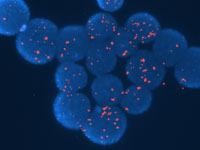
The genome of the Epstein-Barr virus (in red) within lymphoma cells (in blue) detected by fluorescent in situ hybridization
The researchers established DNA "methylomes" for each virus in tissue samples taken from patients in three different disease states: those infected with the virus but with no signs of disease, those with early stage cancer, and those with full blown malignant cancer. The more severe the disease state, the more methylation the researchers saw. That may be because when fewer viral proteins are expressed, the immune system has a harder time recognizing and killing infected cells, the researchers speculate. "We think that the methylation is used by the virus to hide from our immune system," said Esteller. In HPV virus infection, two genes called E6 and E7 are strongly associated with oncogenesis. The researchers noticed heavy methylation of the genes that regulate E6 and E7 in the patient samples from malignant disease. In pre-malignant infections, however, the repressor genes, were still active. The viruses do not contain their own methylation machinery, but instead co-opt the methyltransferase enzymes of the host cell. Once these DNA viruses integrate into the host genome, they are more likely to undergo methylation of oncogenic repressor genes. EBV and HepB have different oncogenic genes than HPV, but those genes were more heavily methylated in the other two viruses as well, the researchers observed. The next step, said Estellar, is to confirm the results in animal models and check whether other viruses, such as HIV, might also be more aggressive with higher levels of methylation. Using oncogenic viruses as a model for epigenetic studies, he said, could shed light on how the epigenetic processes govern regulation of the human genome. Ultimately, Estellar said, methylation patterns could also be used to supplement the diagnosis of cancer stages.
**__Related stories:__***linkurl:Epigenetics:Genome, meet your environment;http://www.the-scientist.com/article/display/14798/
[5th July 2004]*linkurl:An epigenetic inheritance;http://www.the-scientist.com/blog/display/55342/
[19th January 2009]*linkurl:Distinct methylation in stem cell DNA;http://www.the-scientist.com/news/display/24262/
[7th August 2006]
Interested in reading more?

Become a Member of

The Scientist Logo
Receive full access to more than 35 years of archives, as well as TS Digest, digital editions of The Scientist, feature stories, and much more!
Already a member? Login Here

Meet the Author

Share
Illustration of a developing fetus surrounded by a clear fluid with a subtle yellow tinge, representing amniotic fluid.
January 2026, Issue 1

What Is the Amniotic Fluid Composed of?

The liquid world of fetal development provides a rich source of nutrition and protection tailored to meet the needs of the growing fetus.

View this Issue
Skip the Wait for Protein Stability Data with Aunty

Skip the Wait for Protein Stability Data with Aunty

Unchained Labs
Graphic of three DNA helices in various colors

An Automated DNA-to-Data Framework for Production-Scale Sequencing

illumina
Exploring Cellular Organization with Spatial Proteomics

Exploring Cellular Organization with Spatial Proteomics

Abstract illustration of spheres with multiple layers, representing endoderm, ectoderm, and mesoderm derived organoids

Organoid Origins and How to Grow Them

Thermo Fisher Logo

Products

Brandtech Logo

BRANDTECH Scientific Introduces the Transferpette® pro Micropipette: A New Twist on Comfort and Control

Biotium Logo

Biotium Launches GlycoLiner™ Cell Surface Glycoprotein Labeling Kits for Rapid and Selective Cell Surface Imaging

Colorful abstract spiral dot pattern on a black background

Thermo Scientific X and S Series General Purpose Centrifuges

Thermo Fisher Logo
Abstract background with red and blue laser lights

VANTAstar Flexible microplate reader with simplified workflows

BMG LABTECH