The Genetics of Menarche

Hundreds of loci in the genome are associated with the age at which a girl starts menstruating.

Written byKerry Grens
| 1 min read

Register for free to listen to this article
Listen with Speechify
0:00
1:00
Share

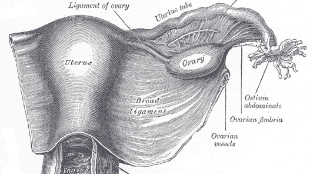
WIKIMEDIA, GRAY'S ANATOMYThe timing of a girl’s first period is inherited, and a study published in Nature this week (July 23) identified more than 100 different spots in the genome tied to menarche. “However our analyses suggest there are likely to be thousands of variants and possibly genes involved in a broad range of biological pathways and processes,” John Perry, the lead author of the study and a geneticist at the University of Cambridge, told the Verge in an e-mail.

More than 180,000 women of European descent participated in the 57 studies used for Perry’s analysis. Some of the influence on the age of menarche appeared to come from imprinted genes—in which a copy from one parent is silenced to favor the expression of the other parent’s copy.

“Our findings imply that in a family, one parent may more profoundly affect puberty timing in their daughters than the other parent,” Perry said in a statement. According to the press release, this is the first time imprinted genes have been linked to controlling development after birth. “We knew that some imprinted genes control antenatal growth and development—but there is increasing interest in the possibility that imprinted genes may also control childhood maturation and later life outcomes, ...

Interested in reading more?

Become a Member of

The Scientist Logo
Receive full access to more than 35 years of archives, as well as TS Digest, digital editions of The Scientist, feature stories, and much more!
Already a member? Login Here

Related Topics

Meet the Author

  • kerry grens

    Kerry served as The Scientist’s news director until 2021. Before joining The Scientist in 2013, she was a stringer for Reuters Health, the senior health and science reporter at WHYY in Philadelphia, and the health and science reporter at New Hampshire Public Radio. Kerry got her start in journalism as a AAAS Mass Media fellow at KUNC in Colorado. She has a master’s in biological sciences from Stanford University and a biology degree from Loyola University Chicago.

    View Full Profile
Share
Image of a woman with her hands across her stomach. She has a look of discomfort on her face. There is a blown up image of her stomach next to her and it has colorful butterflies and gut bacteria all swarming within the gut.
November 2025, Issue 1

Why Do We Feel Butterflies in the Stomach?

These fluttering sensations are the brain’s reaction to certain emotions, which can be amplified or soothed by the gut’s own “bugs".

View this Issue
Olga Anczukow and Ryan Englander discuss how transcriptome splicing affects immune system function in lung cancer.

Long-Read RNA Sequencing Reveals a Regulatory Role for Splicing in Immunotherapy Responses

Pacific Biosciences logo
Research Roundtable: The Evolving World of Spatial Biology

Research Roundtable: The Evolving World of Spatial Biology

Conceptual cartoon image of gene editing technology

Exploring the State of the Art in Gene Editing Techniques

Bio-Rad
Conceptual image of a doctor holding a brain puzzle, representing Alzheimer's disease diagnosis.

Simplifying Early Alzheimer’s Disease Diagnosis with Blood Testing

fujirebio logo

Products

Eppendorf Logo

Research on rewiring neural circuit in fruit flies wins 2025 Eppendorf & Science Prize

Evident Logo

EVIDENT's New FLUOVIEW FV5000 Redefines the Boundaries of Confocal and Multiphoton Imaging

Evident Logo

EVIDENT Launches Sixth Annual Image of the Year Contest

10x Genomics Logo

10x Genomics Launches the Next Generation of Chromium Flex to Empower Scientists to Massively Scale Single Cell Research