Behavior Brief

A round-up of recent discoveries in behavior research

Written byMolly Sharlach
| 5 min read

Register for free to listen to this article
Listen with Speechify
0:00
5:00
Share

KENNETH CATANIA

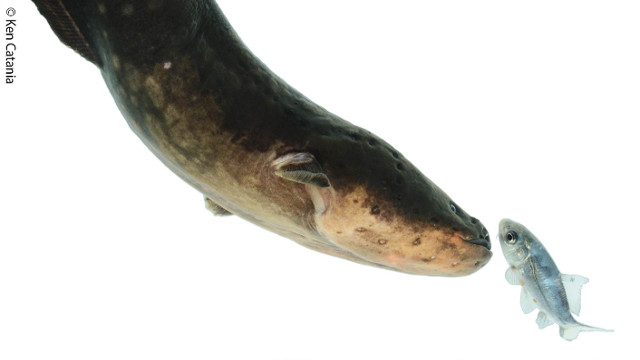
Electric eels (Electrophorus electricus) can emit pulses of electricity as strong as 600 volts; scientists have long assumed the purpose of this behavior was to stun prey. But this Amazonian predator actually manipulates its victims by emitting electricity like a Taser, according to a study published this month (December 5) in Science.

Vanderbilt University biologist Kenneth Catania recorded the electric emissions of four hunting eels and filmed their movements with a high-speed camera. In one set of experiments, he removed the brains of small fish and put up an agar barrier between this prey and the eel. He found that the eel’s electric pulses caused involuntary muscle contractions in the fish.

Injecting the fish with curare, a compound that disrupts neuromuscular connections, made the fish ...

Interested in reading more?

Become a Member of

The Scientist Logo
Receive full access to more than 35 years of archives, as well as TS Digest, digital editions of The Scientist, feature stories, and much more!
Already a member? Login Here
Image of a woman with her hands across her stomach. She has a look of discomfort on her face. There is a blown up image of her stomach next to her and it has colorful butterflies and gut bacteria all swarming within the gut.
November 2025, Issue 1

Why Do We Feel Butterflies in the Stomach?

These fluttering sensations are the brain’s reaction to certain emotions, which can be amplified or soothed by the gut’s own “bugs".

View this Issue
Olga Anczukow and Ryan Englander discuss how transcriptome splicing affects immune system function in lung cancer.

Long-Read RNA Sequencing Reveals a Regulatory Role for Splicing in Immunotherapy Responses

Pacific Biosciences logo
Research Roundtable: The Evolving World of Spatial Biology

Research Roundtable: The Evolving World of Spatial Biology

Conceptual cartoon image of gene editing technology

Exploring the State of the Art in Gene Editing Techniques

Bio-Rad
Conceptual image of a doctor holding a brain puzzle, representing Alzheimer's disease diagnosis.

Simplifying Early Alzheimer’s Disease Diagnosis with Blood Testing

fujirebio logo

Products

Labvantage Logo

LabVantage Solutions Awarded $22.3 Million U.S Customs and Border Protection Contract to Deliver Next-Generation Forensic LIMS

The Scientist Placeholder Image

Evosep Unveils Open Innovation Initiative to Expand Standardization in Proteomics

OGT logo

OGT expands MRD detection capabilities with new SureSeq Myeloid MRD Plus NGS Panel










