Flu Review Criticized

A member of the NSABB biosecurity board that recently reviewed H5N1 data criticizes the process.

Written bySabrina Richards
| 2 min read

Register for free to listen to this article
Listen with Speechify
0:00
2:00
Share

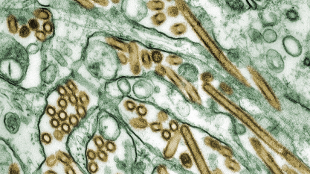
Colorized transmission electron micrograph of Avian influenza A H5N1 viruses (seen in gold) grown in MDCK cells (seen in green).WIKIMEDIA COMMONS, CDC

The process leading to the US biosecurity board recommending full publication of two controversial H5N1 flu papers has been criticized by a board member in a letter sent to the National Institutes of Health last week (April 12). Influenza epidemiologist Michael Osterholm of the University of Minnesota, Twin Cities, outlined his criticisms to Amy Patterson, associate director for science policy at the NIH, reported Nature.

The US National Science Advisory Board for Biosecurity (NSABB) had previously recommended that the two controversial H5N1 papers, which detailed mutations that allow for ferret-to-ferret aerosol transmission, be published in redacted form, a recommendation that was rescinded at last month’s meeting. Osterholm himself voted for publication of one paper, but was concerned that modifications to the second paper did not ...

Interested in reading more?

Become a Member of

The Scientist Logo
Receive full access to more than 35 years of archives, as well as TS Digest, digital editions of The Scientist, feature stories, and much more!
Already a member? Login Here

Related Topics

Meet the Author

Share
Illustration of a developing fetus surrounded by a clear fluid with a subtle yellow tinge, representing amniotic fluid.
January 2026, Issue 1

What Is the Amniotic Fluid Composed of?

The liquid world of fetal development provides a rich source of nutrition and protection tailored to meet the needs of the growing fetus.

View this Issue
Skip the Wait for Protein Stability Data with Aunty

Skip the Wait for Protein Stability Data with Aunty

Unchained Labs
Graphic of three DNA helices in various colors

An Automated DNA-to-Data Framework for Production-Scale Sequencing

illumina
Exploring Cellular Organization with Spatial Proteomics

Exploring Cellular Organization with Spatial Proteomics

Abstract illustration of spheres with multiple layers, representing endoderm, ectoderm, and mesoderm derived organoids

Organoid Origins and How to Grow Them

Thermo Fisher Logo

Products

Brandtech Logo

BRANDTECH Scientific Introduces the Transferpette® pro Micropipette: A New Twist on Comfort and Control

Biotium Logo

Biotium Launches GlycoLiner™ Cell Surface Glycoprotein Labeling Kits for Rapid and Selective Cell Surface Imaging

Colorful abstract spiral dot pattern on a black background

Thermo Scientific X and S Series General Purpose Centrifuges

Thermo Fisher Logo
Abstract background with red and blue laser lights

VANTAstar Flexible microplate reader with simplified workflows

BMG LABTECH










