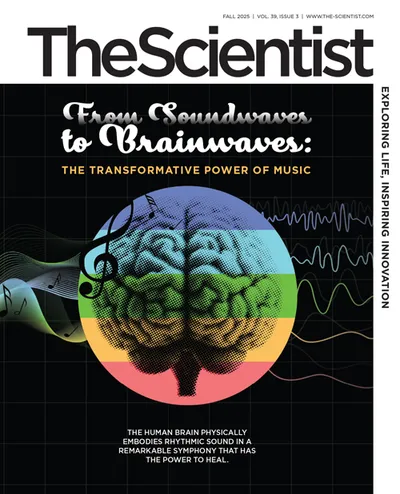
Life begins with music. The human body provides the basic musical elements for the soundtrack to fetal development. The rhythmic pulsing of mom’s heartbeat, the rise and fall of her footsteps, the steady rush of her breathing and circulation, the pitch and melody of her voice, and the rumbling staccatos of her digestion all prime the developing fetus to recognize and respond to music postnatally.1,2 Womb sounds shape brain development, form the basis of future language and communication, and program musical dialects into the fleshy enclaves of the body.
“Human bodies are made up of these periodic oscillations, [and] we are wired to respond to patterns of sound that change over time,” said Caroline Palmer, a cognitive neuroscientist at McGill University, who studies how the human brain and body respond to music. “People resonate to music. They respond positively in ways that suggest that the rhythms of the brain and body, like neurons, breathing, or cardiac rhythms, are engaged when you listen to music.”
Riding the Soundwave
The human brain has musical features integrated into its physiological patterns. The intrinsic rhythm of brainwaves, those natural oscillations that underlie consciousness, cognition, creativity, dreams, and everything in between, form the basis of musical perception and cognition. Researchers are increasingly interested in understanding how human brainwaves synchronize their frequency to musical rhythm. Humans innately experience this when bopping to a beat. Palmer and her team aim to unravel the neuroscience behind this phenomenon using computational models of how the human brain perceives and coordinates auditory sequences.3
Among her team’s key findings is the brain’s ability to fill in beat pauses while listening to rhythmic music.4 “If you measure what the brain is doing during the missing beats in the music using magnetoencephalography or electroencephalography, you can see that it’s still resonating. It’s emitting a pulse and filling in when the rhythm matches the frequency or the periodicity of the brain’s rhythms,” Palmer explained. “In other words, our brain isn’t just predicting music, it’s actually physically synchronizing with the music.” This dynamic physical embodiment of music depends on the brain’s ability to synchronize with rhythm, something that newborns within a week of birth can do. “That suggests that indeed we are wired this way at birth,” Palmer said. This innate tendency exists across cultures, ages, and musical inclinations, supporting the power of music as a universally unifying language.
People resonate to music. They respond positively in ways that suggest that the rhythms of the brain and body, like neurons, breathing, or cardiac rhythms, are engaged when you listen to music.
—Caroline palmer, McGill university
There are nevertheless individual differences. “It may not be the same kind of synchrony for each person. In a large audience, you can see some people tapping their foot to perhaps the bass or drums and someone else might be bobbing their heads to the guitar rhythm,” Palmer said. “We’re not just passively predicting what’s going to come next. We’re actively resonating, moving in response to the music at certain rhythms that naturally entrain our bodies to the external sound.”
Beat as a Balm
The therapeutic value of music has been demonstrated for many different conditions, such as depression, anxiety, stress, chronic pain, and neurological disorders.5 Among the most fascinating applications are those for brain disorders that involve a loss of physiological rhythmicity. “There are lots of examples where music, something rhythmic, helps humans,” Palmer said. “Music is used with individuals who have a stroke and perhaps lose their ability to speak, or [have] Parkinson’s disease, where they lose their ability to walk [with] a steady gait.”
For stroke survivors recovering from speech and language deficits, listening to music with a regular beat produces speech entrainment, allowing speech patterns to mimic the rhythm.6,7 “An individual who has aphasia, loss of language following stroke, may stumble over the syllables in words. They might have trouble producing two or three or more syllables in a row, but if they listen to a regular beat, they are able to then speak at that regular beat,” Palmer explained. Music therapy can help rehabilitate speech and language abilities over time.
Many such patients who struggle with speech fluency can sing with ease. Such spared musical abilities have been observed in patients with severe speech and language deficits for over 100 years. While some of the underlying mechanisms relate to neuroplastic changes, the rhythmic stimulation and intonation of singing are also thought to play an important role.8–12 Rhythmic entrainment may improve oral motor control, respiration, voice quality, and speech fluidity.
Leonardo Bonetti, a cognitive neuroscientist at Aarhus University’s Center for Music in the Brain and the University of Oxford’s Centre for Eudaimonia and Human Flourishing also acknowledges the therapeutic potential of music. “We know that rhythmic stimulation can help people [move] better. That helps with Parkinson’s or even in people who are healthy, like athletes or musicians,” Bonetti said. “If you have a metronome, you tend to improve your movements.”
Among the characteristic deficits of Parkinson’s disease are a slow, shuffling gait and difficulty initiating and maintaining normal walking rhythm due to insufficient dopamine signaling in brain regions that control voluntary movements. Rhythmic music can improve the way patients suffering from Parkinson’s disease move by overriding the faulty neural pathways that typically maintain internal timing for rhythmic actions such as walking.13–16 Listening to rhythmic music stimulates intact auditory pathways in the brain that can then trigger activity in motor regions. In this way, external rhythmic musical cues act as a metronome to entrain movement. Activities that incorporate music and movement, such as dance, are particularly beneficial for those afflicted by Parkinson’s disease. For example, regular dancing has been shown to improve gait, coordination, and balance in patients with Parkinson’s disease.17
The Beat Goes On
Bonetti is also interested in how the brain responds to rhythmic sounds in time and space. “Music is not just about listening,” Bonetti said. “The brain reshapes its functional organization.” To see how this happens, Bonetti and his team developed advanced algorithms to help tease apart the activity of different brain networks from magnetoencephalography recordings.
They found that the human brain responds to rhythm by tuning into the frequency of the sound as well as reshaping brainwave activity across different interconnected regions.18 “Networks reshape themselves in terms of the spatial locations and also the prominence in terms of the specific frequency content,” Bonetti said. “The brain is very complex. There are multiple networks that are active at the same time [with] different strengths.” These can include an entirely new emergent network of activity that was not present before hearing the rhythmic sound, the rearrangement of previously present networks of activity, or minimally changing patterns of activity in time and space. Music cognition goes far beyond perceiving the auditory stimulus. The attunement involves dynamic shifts in brainwave frequency and regional activity. Bonetti noted the significance of the location of emerging activity, with a transition towards brain regions that control motor activity. “[The] beat was probably engaging more of these motor regions already at this particularly frequency,” he said. “Listening to the beat would help people to, in a way, be more ready to be active. It might be interpreted as a sort of readiness to action…but this is a bit of speculation.”
At the anatomical level, the brain on music can be likened to a jazz ensemble, with different brain regions riffing off the auditory input and one another in real time to create a rich and dynamic symphony of activity. The transformative power of music has been recognized across cultures and ages long before the British poet, William Congreve, coined the original version of the now famous idiom “music soothes the savage beast” in 1697. As modern neuroscience catches up to ancient understandings, new findings about how music affects the brain across all life stages and cultures continue to emerge.
- Ullal-Gupta S, et al.Linking prenatal experience to the emerging musical mind. Front Syst Neurosci. 2013;7:48.
- Teie D. A comparative analysis of the universal elements of music and the fetal environment. Front Psychol. 2016;7:1158.
- Harding EE, et al. Musical neurodynamics. Nat Rev Neurosci. 2025;26(5):293-307.
- Mathias B, et al. Rhythm complexity modulates behavioral and neural dynamics during auditory-motor synchronization. J Cogn Neurosci. 2020;32(10):1864-1880.
- Thaut MH, et al. Neurobiological foundations of neurologic music therapy: Rhythmic entrainment and the motor system. Front Psychol. 2015;5:1185.
- Sihvonen AJ, et al. Structural neuroplasticity effects of singing in chronic aphasia. eNeuro. 2024;11 (5):ENEURO.0408-23.2024
- Schlaug G, et al. From singing to speaking: facilitating recovery from nonfluent aphasia. Future Neurol. 2010;5(5):657-665.
- Stahl B, et al. Rhythm in disguise: Why singing may not hold the key to recovery from aphasia. Brain. 2011;134(10):3083-3093.
- Wan CY, et al. The therapeutic effects of singing in neurological disorders. Music Percept. 2010;27(4):287-295.
- Zumbansen A, et al. The combination of rhythm and pitch can account for the beneficial effect of melodic intonation therapy on connected speech improvements in Broca’s aphasia. Front Hum Neurosci. 2014;8:592.
- Schlaug G, et al. From singing to speaking: Why singing may lead to recovery of expressive language function in patients with Broca’s aphasia. Music Percept. 2008;25(4):315–323.
- Gong D, Ye F. Effects of music therapy on aphasia and cognition of patients with post-stroke: A systematic review and meta-analysis. Noise Health. 2024;26(121):136-141.
- Ashoori A, et al. Effects of auditory rhythm and music on gait disturbances in Parkinson’s disease. Front Neurol. 2015;6:234.
- Nombela C, et al. Into the groove: Can rhythm influence Parkinson’s disease?. Neurosci Biobehav Rev. 2013;37(10 Pt 2):2564-2570.
- Tolleson CM, et al. Dysrhythmia of timed movements in Parkinson’s disease and freezing of gait. Brain Res. 2015;1624:222-231.
- Leuk JSP, e al. An overview of acoustic-based interventions to improve motor symptoms in Parkinson’s disease. Front Aging Neurosci. 2020;12:243.
- Wu CC, et al. Dance movement therapy for neurodegenerative diseases: A systematic review. Front Aging Neurosci. 2022;14:975711.
- Rosso M, et al. FREQ-NESS reveals the dynamic reconfiguration of frequency-resolved brain networks during auditory stimulation. Adv Sci. 2025;12(20):e2413195.