


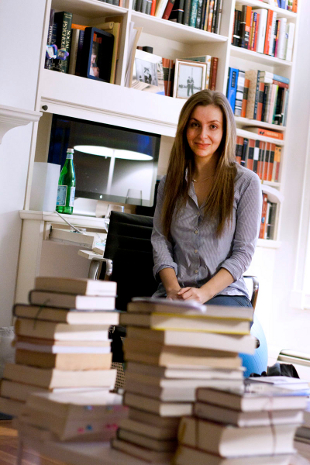
 JOSS FONG“I tell this to everyone,” Maria Konnikova said in a delicate voice, poised atop a blue exercise ball: “I think you lead an impoverished life if you only read nonfiction.” Her stylish Manhattan apartment is spotless save one detail—the coffee table in her airy living room is covered with stacks of books. Speaking with Konnikova, you get the sense that the books, more than the apartment, are her real home.
Konnikova is a Russian-born doctoral candidate in psychology at Columbia University, where her research probes the minds of people with high self-control. She is also a prolific freelance writer and is working on a novel. Her first book Mastermind: How to Think Like Sherlock Holmes, which combines insights from psychological science and Sir Arthur Conan Doyle’s stories, was released last week (January 3).
“I think the best psychologists are actually fiction writers,” Konnikova said. “Their understanding of the human mind is so far beyond where we've been able to get with psychology as a science.”
The narrow focus required by scientific research can miss the big picture, Konnikova said; researchers often tinker around the edges of wisdom elucidated by novelists a hundred years ago. “You ...












