Migrating Monarch Numbers Rebound

The iconic butterflies have flocked to their Mexican overwintering grounds, seemingly reversing recent population declines.

Written byBob Grant
| 2 min read

Register for free to listen to this article
Listen with Speechify
0:00
2:00
Share

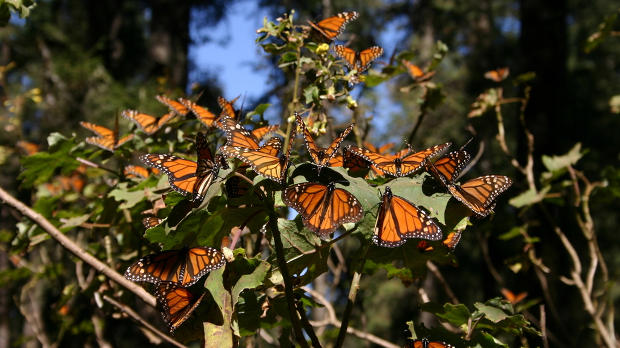
Monarchs in Michoacan, MexicoWIKIMEDIA, SCOTT CLARKResearchers and conservationists are breathing guarded sighs of relief after a new analysis of the area of forest covered by monarch butterflies at hibernation sites in central Mexico last year was more than three times larger than the previous year. The World Wildlife Fund (WWF) announced the findings in Mexico City last week (February 26).

While the 10 acres that hibernating monarchs covered in Michoacán State and Mexico State was more than the 2.79 acres they covered in 2014 and the 1.66 acres they covered in 2013, it is nowhere near the approximately 45 acres the insects covered in 1996. “Now more than ever, Mexico, the United States, and Canada should increase their conservation efforts to protect and restore the habitat of this butterfly along its migratory route,” Omar Vidal, director general for WWF-Mexico, said in a statement.

Daniel Ashe, director of the US Fish and Wildlife Service, agreed. “We are seeing the beginning of success,” he told The New York Times. “Our task now is to continue building on that success.”

Though the issue of monarch butterfly decline is ...

Interested in reading more?

Become a Member of

The Scientist Logo
Receive full access to more than 35 years of archives, as well as TS Digest, digital editions of The Scientist, feature stories, and much more!
Already a member? Login Here

Related Topics

Meet the Author

  • From 2017 to 2022, Bob Grant was Editor in Chief of The Scientist, where he started in 2007 as a Staff Writer. Before joining the team, he worked as a reporter at Audubon and earned a master’s degree in science journalism from New York University. In his previous life, he pursued a career in science, getting a bachelor’s degree in wildlife biology from Montana State University and a master’s degree in marine biology from the College of Charleston in South Carolina. Bob edited Reading Frames and other sections of the magazine.

    View Full Profile
Share
Illustration of a developing fetus surrounded by a clear fluid with a subtle yellow tinge, representing amniotic fluid.
January 2026, Issue 1

What Is the Amniotic Fluid Composed of?

The liquid world of fetal development provides a rich source of nutrition and protection tailored to meet the needs of the growing fetus.

View this Issue
Skip the Wait for Protein Stability Data with Aunty

Skip the Wait for Protein Stability Data with Aunty

Unchained Labs
Graphic of three DNA helices in various colors

An Automated DNA-to-Data Framework for Production-Scale Sequencing

illumina
Exploring Cellular Organization with Spatial Proteomics

Exploring Cellular Organization with Spatial Proteomics

Abstract illustration of spheres with multiple layers, representing endoderm, ectoderm, and mesoderm derived organoids

Organoid Origins and How to Grow Them

Thermo Fisher Logo

Products

Brandtech Logo

BRANDTECH Scientific Introduces the Transferpette® pro Micropipette: A New Twist on Comfort and Control

Biotium Logo

Biotium Launches GlycoLiner™ Cell Surface Glycoprotein Labeling Kits for Rapid and Selective Cell Surface Imaging

Colorful abstract spiral dot pattern on a black background

Thermo Scientific X and S Series General Purpose Centrifuges

Thermo Fisher Logo
Abstract background with red and blue laser lights

VANTAstar Flexible microplate reader with simplified workflows

BMG LABTECH










