Northern Exposure

Researchers are using snowdrifts to artificially warm Arctic tundra during winter and finding that more carbon is released from the soil than plants can soak up from the atmosphere.

Written byJef Akst
| 5 min read

Register for free to listen to this article
Listen with Speechify
0:00
5:00

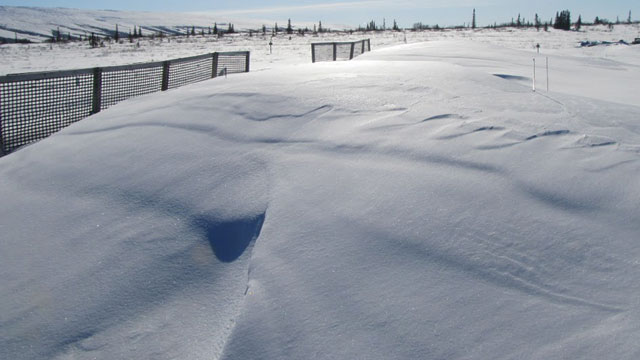
BLANKET OF WHITE: (Top) Snowpack on top of some plots in the winter insulated the ground and simulated a warming climate.PHOTO BY JJ NEVILLE; ANDRES BARON

For five straight years, from 2008 to 2012, ecosystem ecologist Sue Natali traveled to Alaska every spring for what she calls her mental vacation. For two weeks in April or May, Natali, then a postdoctoral researcher in the lab of Ted Schuur at the University of Florida, worked alongside other postdocs, students, and even a few locals from the nearby town of Healy to remove mounds of snow from their experimental plots in rolling fields in the shadow of Denali National Park.

“It’s long days,” Natali says, a hint of exhaustion in her voice as she recalls the laborious experience. “We shovel the old-fashioned way with shovels and sleds [because] we don’t want to disturb the plants. . .Everybody’s sore [from the work], but it’s ...

Interested in reading more?

Become a Member of

The Scientist Logo
Receive full access to digital editions of The Scientist, as well as TS Digest, feature stories, more than 35 years of archives, and much more!
Already a member?
Add The Scientist as a preferred source on Google

Add The Scientist as a preferred Google source to see more of our trusted coverage.

Meet the Author

  • Jef (an unusual nickname for Jennifer) got her master’s degree from Indiana University in April 2009 studying the mating behavior of seahorses. After four years of diving off the Gulf Coast of Tampa and performing behavioral experiments at the Tennessee Aquarium in Chattanooga, she left research to pursue a career in science writing. As The Scientist's managing editor, Jef edited features and oversaw the production of the TS Digest and quarterly print magazine. In 2022, her feature on uterus transplantation earned first place in the trade category of the Awards for Excellence in Health Care Journalism. She is a member of the National Association of Science Writers.

    View Full Profile

Related Topics

Published In

Related articles background image
August 2026 Digest cover
August 2026

Epic Fail: Sea-Monkeys Sabotage Fieldwork

When Barry Hicks set out to photograph thrombolites, thousands of unexpected visitors photobombed his underwater images.

View this Issue
Overcoming Immunotherapy Resistance in Liver Cancer

Overcoming Immunotherapy Resistance in Liver Cancer

Axion Biosystems
Optimizing NGS Library Preparation for Reliable Sequencing Data

Optimizing NGS Library Preparation for Reliable Sequencing Data

Covaris
Using TCR Repertoire Sequencing to Advance Immunology Research

Using TCR Repertoire Sequencing to Advance Immunology Research

Miltenyi
Mapping Clonal Mosaicism in Aging Tissues

Mapping Clonal Mosaicism in Aging Tissues

Mission bio

Products

Sino Biological Logo

Sino Biological Launches SuperNuclease ® Pro with Free Trial Program

Sino Biological Logo

Sino Biological Launches Precisely Characterized Full-Length p-Tau217 Protein to Advance Next-Generation Alzheimer’s Biomarker Assay Development

A photo of a scientist placing the Resipher device on a 96-well plate.

Resipher: Continuous Live-Cell Mitochondrial Respiration Monitoring in 96-Well Plates

Lucid Scientific logo
Conceptual image of ice and frost.

The VAULT100 PRO: Inside the most advanced Stirling Ultracold ULT freezer ever built.

Stirling Ultracold logo










