


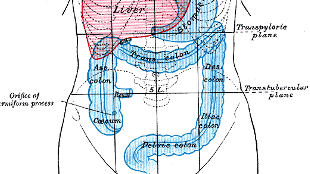
 WIKIMEDIA, GRAY'S ANATOMYPhony poo containing 33 isolates of commensal microbes cured two patients suffering from recurrent intestinal infections of Clostridium difficile after doctors infused the fake fecal matter into their colons during a colonoscopy. The successful insertion of synthetic stool, published today in Microbiome, provides hope for a much-needed treatment against diarrhea-causing, often drug-resistant infections by C. difficile, for which conventional fecal transplant therapies have failed to develop.
“Fecal bacteriotherapy, or ‘stool transplant,’ . . . has shown promising results in preliminary studies, but concerns about pathogen transmission, patient acceptance, and inability to standardize the treatment regimen remain,” the authors wrote in the study. “This proof-of-principle study demonstrates that a stool substitute mixture comprising a multi-species community of bacteria is capable of curing antibiotic-resistant C. difficile colitis.”
The two patients involved in the study suffered from a hyper-virulent strain of C. difficile known as ribotype 078, which was unscathed by courses of the antibiotic metronidazole and the “last resort” antibiotic, vancomycin. But 2 to 3 days after the synthetic stool transplant, both patients rid their symptoms and remained symptom-free for at least 6 months. Moreover, DNA sequencing of the patients’ stool samples taken ...












