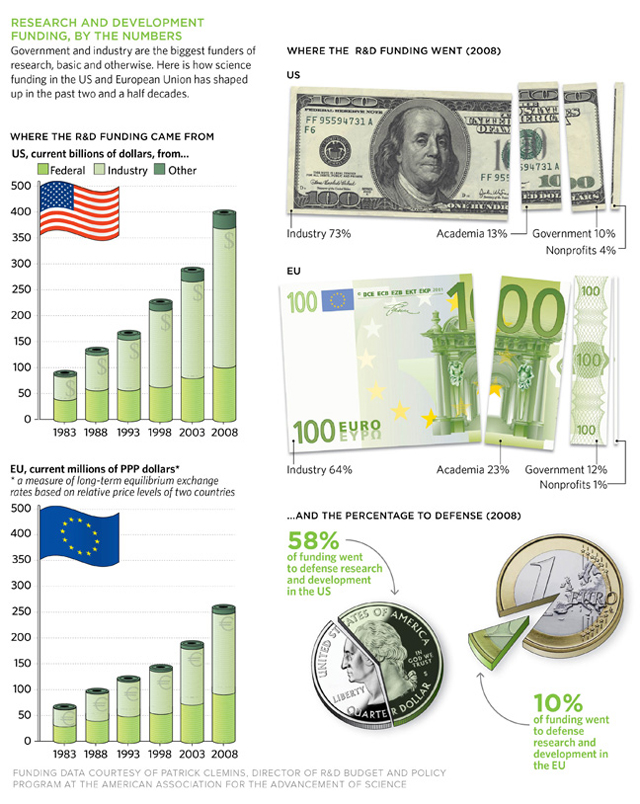
Research and Development Funding, By the Numbers

Government and industry are the biggest funders of research, basic and otherwise. Here is how science funding in the US and European Union has shaped up in the past two and a half decades. 

Written byBob Grant
| 1 min read

Register for free to listen to this article
Listen with Speechify
0:00
1:00

FUNDING DATA COURTESY OF PATRICK CLEMINS, DIRECTOR OF R&D BUDGET AND POLICY PROGRAM AT THE AMERICAN ASSOCIATION FOR THE ADVANCEMENT OF SCIENCE

Government and industry are the biggest funders of research, basic and otherwise. Here is how science funding in the US and European Union has shaped up in the past two and a half decades.

Correction (November 3): The original version of the chart showing the sources of US R&D investment from 1983-2008 were incorrect in absolute scale. The mistake has been fixed, and The Scientist regrets the error.

View a pdf

Read the full story.

Interested in reading more?

Become a Member of

The Scientist Logo
Receive full access to digital editions of The Scientist, as well as TS Digest, feature stories, more than 35 years of archives, and much more!
Already a member?
Add The Scientist as a preferred source on Google

Add The Scientist as a preferred Google source to see more of our trusted coverage.

Meet the Author

  • From 2017 to 2022, Bob Grant was Editor in Chief of The Scientist, where he started in 2007 as a Staff Writer. Before joining the team, he worked as a reporter at Audubon and earned a master’s degree in science journalism from New York University. In his previous life, he pursued a career in science, getting a bachelor’s degree in wildlife biology from Montana State University and a master’s degree in marine biology from the College of Charleston in South Carolina. Bob edited Reading Frames and other sections of the magazine.

    View Full Profile

Related Topics

Published In

Related articles background image
August 2026 Digest cover
August 2026

Epic Fail: Sea-Monkeys Sabotage Fieldwork

When Barry Hicks set out to photograph thrombolites, thousands of unexpected visitors photobombed his underwater images.

View this Issue
Advancing Respiratory Immunity Through Tissue-Resident Memory T Cell Research

Advancing Respiratory Immunity Through Tissue-Resident Memory T Cell Research

Miltenyi
Overcoming Immunotherapy Resistance in Liver Cancer

Overcoming Immunotherapy Resistance in Liver Cancer

Axion Biosystems
Optimizing NGS Library Preparation for Reliable Sequencing Data

Optimizing NGS Library Preparation for Reliable Sequencing Data

Covaris
Using TCR Repertoire Sequencing to Advance Immunology Research

Using TCR Repertoire Sequencing to Advance Immunology Research

Miltenyi

Products

Sino Biological Logo

Sino Biological Launches SuperNuclease ® Pro with Free Trial Program

Sino Biological Logo

Sino Biological Launches Precisely Characterized Full-Length p-Tau217 Protein to Advance Next-Generation Alzheimer’s Biomarker Assay Development

A photo of a scientist placing the Resipher device on a 96-well plate.

Resipher: Continuous Live-Cell Mitochondrial Respiration Monitoring in 96-Well Plates

Lucid Scientific logo
Conceptual image of ice and frost.

The VAULT100 PRO: Inside the most advanced Stirling Ultracold ULT freezer ever built.

Stirling Ultracold logo










