Targeting RNA-Binding Proteins

An RNA-binding protein fused with the catalytic domain of an RNA-editing enzyme makes for easier identification of the binding protein's target—a boon for studying gene expression and cellular functions in small amounts of material.

Written byRuth Williams
| 1 min read

Register for free to listen to this article
Listen with Speechify
0:00
1:00
Share

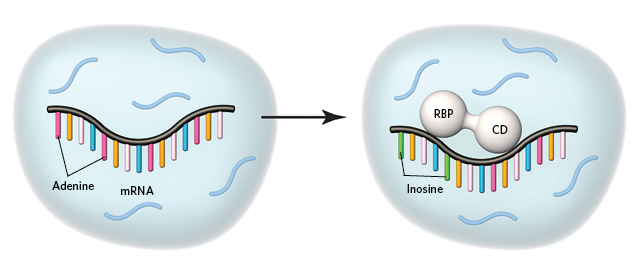
TRIBE method for identifying RNAs that interact with ribosome-binding proteins (RBPs) fuses an RBP of interest to the catalytic domain (CD) of an RNA-editing enzyme. When the RBP-CD fusion protein binds to the RBP’s specific RNA targets, the CD converts adenine nucleotides to inosine nucleotides. Extraction and RNA sequencing thus reveals those RNAs with altered sequences.
© GEORGE RETSECKRNA Tagging fuses an RBP of interest to an enzyme that attaches chains of uridines (U) to the ends of the RBP’s target RNAs. The poly-U tails are then used to identify targets during RNA sequencing. © GEORGE RETSECK

Read the full story.

Interested in reading more?

Become a Member of

The Scientist Logo
Receive full access to more than 35 years of archives, as well as TS Digest, digital editions of The Scientist, feature stories, and much more!
Already a member? Login Here

Meet the Author

  • ruth williams

    Ruth is a freelance journalist. Before freelancing, Ruth was a news editor for the Journal of Cell Biology in New York and an assistant editor for Nature Reviews Neuroscience in London. Prior to that, she was a bona fide pipette-wielding, test tube–shaking, lab coat–shirking research scientist. She has a PhD in genetics from King’s College London, and was a postdoc in stem cell biology at Imperial College London. Today she lives and writes in Connecticut.

    View Full Profile
Share
December digest cover image of a wooden sculpture comprised of multiple wooden neurons that form a seahorse.
December 2025, Issue 1

Wooden Neurons: An Artistic Vision of the Brain

A neurobiologist, who loves the morphology of cells, turns these shapes into works of art made from wood.

View this Issue
Stacks of cell culture dishes, plates, and flasks with pink cell culture medium on a white background.

Driving Innovation with Cell Culture Essentials

Merck
Stacks of cell culture dishes, plates, and flasks with pink cell culture medium on a white background.

Driving Innovation with Cell Culture Essentials

MilliporeSigma purple logo
Human iPSC-derived Models for Brain Disease Research

Human iPSC-derived Models for Neurodegenerative Disease Research

Fujifilm
Abstract wireframe sphere with colorful dots and connecting lines representing the complex cellular and molecular interactions within the tumor microenvironment.

Exploring the Inflammatory Tumor Microenvironment 

Cellecta logo

Products

brandtech logo

BRANDTECH® Scientific Announces Strategic Partnership with Copia Scientific to Strengthen Sales and Service of the BRAND® Liquid Handling Station (LHS) 

Top Innovations 2026 Contest Image

Enter Our 2026 Top Innovations Contest

Biotium Logo

Biotium Expands Tyramide Signal Amplification Portfolio with Brighter and More Stable Dyes for Enhanced Spatial Imaging

Labvantage Logo

LabVantage Solutions Awarded $22.3 Million U.S Customs and Border Protection Contract to Deliver Next-Generation Forensic LIMS







