Will Marches Help Science? People Are Divided, Survey Finds

National opinions about the effectiveness of last month’s science and climate marches are mixed and follow political lines, a Pew survey reports.

Written byAshley P. Taylor
| 2 min read

Register for free to listen to this article
Listen with Speechify
0:00
2:00

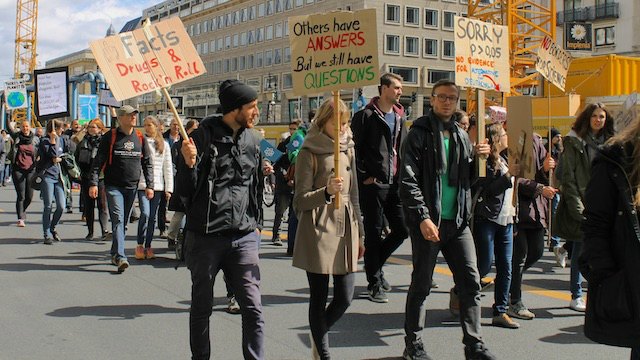
March for Science, Berlin, Germany, April 22, 2017DIANA KWONOpinions are divided about whether April’s marches for science and climate will effect political change, according to a Pew Research Center survey conducted earlier this month.

Those opinions cleave along political and generational lines, the survey found. For example, 44 percent of respondents think the marches will increase public support for science, while the same percentage said the marches will make no difference. Of Democrats and democratic-leaning Independents, about 60 percent think the marches will increase support for science, and roughly the same percentage of Republicans and republican-leaning Independents anticipate the marches will have no effect. A little more than half of younger adults (ages 18 to 29) expect the marches will make a difference, while a similar percentage of senior citizens (ages 65 and older) think they will not.

“The data speak to the difficulties of making the case for science in the politically polarized environment,” Cary Funk, lead author ...

Interested in reading more?

Become a Member of

The Scientist Logo
Receive full access to more than 35 years of archives, as well as TS Digest, digital editions of The Scientist, feature stories, and much more!
Already a member?
Add The Scientist as a preferred source on Google

Add The Scientist as a preferred Google source to see more of our trusted coverage.

Meet the Author

Related Topics

Related articles background image
The Scientist Digest cover September 2026
September 2026

Multiplex Microscopy Becomes Easier with Encoded Antibodies

A new system that enables researchers to uniquely tag monoclonal antibodies for use in microscopy could help simplify complex imaging studies.

View this Issue
Rethinking ALS Biomarkers: From Discovery to Clinical Impact

Rethinking ALS Biomarkers: From Discovery to Clinical Impact

Alamar Biosciences logo
Best Practices for qPCR Assay Design and Optimization

Best Practices for qPCR Assay Design and Optimization

Bio-Rad
Beyond the Basics: Strategies for Single-Cell and Spatial Transcriptomics Analysis

Beyond the Basics: Strategies for Single-Cell and Spatial Transcriptomics Analysis

bioxcell
Scientist reviewing cellular and molecular data on a computer in a laboratory.

Building Translation-Ready Biomarkers with Connected Workflows

Danaher Logo

Products

Closeup image of a multi channel pipette dispensing pink liquid into a 96-well plate.

The ASSIST PLUS pipetting robot for affordable workflow automation

Integra Logo
Single cells in suspension

Rapidly isolate primary cells and make uniform single-cell suspensions with Corning® Cell Strainers

Corning logo
Abstract image representing cell membranes linked together.

CellBrite® Steady Membrane Stain: Cell surface staining built for real-time imaging

Biotium
sino biological logo

Monod Bio Licenses AI-designed Protein Technologies to SignalChem Biotech for Custom Discovery Assays










