Amphibians Face Another Fungal Threat

Joining Bd, a newly identified chytrid fungus can be lethal to European salamanders and newts.

Written byJyoti Madhusoodanan
| 3 min read

Register for free to listen to this article
Listen with Speechify
0:00
3:00
Share

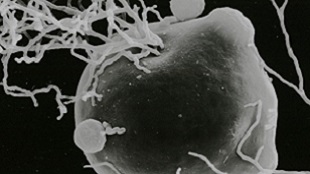
B. salamandrivoransPNAS, MARTEL ET AL.

More than 200 frogs, toads, and other amphibian species around the world are threatened by a lethal skin disease caused by the chytrid fungus Batrachochytrium dendrobatidis (Bd). Last year, a related pathogen was discovered decimating populations of fire salamanders in the Netherlands and Belgium. The new microscopic killer, known as B. salamandrivorans (Bs), is only the second known species of its kind found to infect vertebrate hosts.

Now, an analysis of more than 5,000 amphibians from four continents suggests that Bs may have spread from Asia to Europe through pet trade. The results, published today (October 30) in Science, also reveal the extent to which other amphibian species are vulnerable to the fungus. So far, European newts and salamanders appear to be the most severely ...

Interested in reading more?

Become a Member of

The Scientist Logo
Receive full access to more than 35 years of archives, as well as TS Digest, digital editions of The Scientist, feature stories, and much more!
Already a member? Login Here

Related Topics

Meet the Author

Share
Illustration of a developing fetus surrounded by a clear fluid with a subtle yellow tinge, representing amniotic fluid.
January 2026, Issue 1

What Is the Amniotic Fluid Composed of?

The liquid world of fetal development provides a rich source of nutrition and protection tailored to meet the needs of the growing fetus.

View this Issue
Skip the Wait for Protein Stability Data with Aunty

Skip the Wait for Protein Stability Data with Aunty

Unchained Labs
Graphic of three DNA helices in various colors

An Automated DNA-to-Data Framework for Production-Scale Sequencing

illumina
Exploring Cellular Organization with Spatial Proteomics

Exploring Cellular Organization with Spatial Proteomics

Abstract illustration of spheres with multiple layers, representing endoderm, ectoderm, and mesoderm derived organoids

Organoid Origins and How to Grow Them

Thermo Fisher Logo

Products

Brandtech Logo

BRANDTECH Scientific Introduces the Transferpette® pro Micropipette: A New Twist on Comfort and Control

Biotium Logo

Biotium Launches GlycoLiner™ Cell Surface Glycoprotein Labeling Kits for Rapid and Selective Cell Surface Imaging

Colorful abstract spiral dot pattern on a black background

Thermo Scientific X and S Series General Purpose Centrifuges

Thermo Fisher Logo
Abstract background with red and blue laser lights

VANTAstar Flexible microplate reader with simplified workflows

BMG LABTECH










