Exercise Boosts Telomere Transcription

Endurance exercise and metabolism are linked to transcriptional activation of human telomeres, researchers propose.

Written byAnna Azvolinsky
| 3 min read

Register for free to listen to this article
Listen with Speechify
0:00
3:00
Share

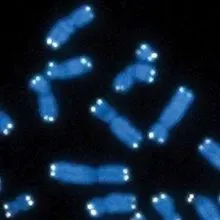
FLICKR, NIHWhen healthy individuals perform a cardiovascular workout, their muscles increase transcription of telomeres, according to a study published today (July 27) in Science Advances. The team also identifies a novel transcription factor that appears to promote telomere transcription and provides the first direct evidence that telomere transcription is linked to exercise and metabolism in people.

“The novelty and merit of this work is that the authors demonstrate, for the first time, that [telomere transcription] occurs in response to physical exercise in a physiological system—human muscle,” Claus Azzalin, who studies telomere transcription at ETH Zurich in Switzerland but was not involved in the work, wrote in an email to The Scientist.

“This is a new link between metabolism and telomeres,” said study coauthor Anabelle Decottignies of the de Duve Institute in Brussels, Belgium. “We were able to show that metabolism, in the form of exercise, can promote transcription at telomeres.”

Telomeres were thought to be transcriptionally silent until several years ago when researchers found that mammalian telomeres, including human ones, are readily transcribed into telomeric repeat–containing RNA (TERRA). These RNA molecules ...
Interested in reading more?

Become a Member of

The Scientist Logo
Receive full access to more than 35 years of archives, as well as TS Digest, digital editions of The Scientist, feature stories, and much more!
Already a member? Login Here

Related Topics

Meet the Author

  • head shot of blond woman wearing glasses

    Anna Azvolinsky received a PhD in molecular biology in November 2008 from Princeton University. Her graduate research focused on a genome-wide analyses of genomic integrity and DNA replication. She did a one-year post-doctoral fellowship at Memorial Sloan Kettering Cancer Center in New York City and then left academia to pursue science writing. She has been a freelance science writer since 2012, based in New York City.

    View Full Profile
Share
February 2026

A Stubborn Gene, a Failed Experiment, and a New Path

When experiments refuse to cooperate, you try again and again. For Rafael Najmanovich, the setbacks ultimately pushed him in a new direction.

View this Issue
Human-Relevant In Vitro Models Enable Predictive Drug Discovery

Advancing Drug Discovery with Complex Human In Vitro Models

Stemcell Technologies
Redefining Immunology Through Advanced Technologies

Redefining Immunology Through Advanced Technologies

Ensuring Regulatory Compliance in AAV Manufacturing with Analytical Ultracentrifugation

Ensuring Regulatory Compliance in AAV Manufacturing with Analytical Ultracentrifugation

Beckman Coulter Logo
Conceptual multicolored vector image of cancer research, depicting various biomedical approaches to cancer therapy

Maximizing Cancer Research Model Systems

bioxcell

Products

Sino Biological Logo

Sino Biological Pioneers Life Sciences Innovation with High-Quality Bioreagents on Inside Business Today with Bill and Guiliana Rancic

Sino Biological Logo

Sino Biological Expands Research Reagent Portfolio to Support Global Nipah Virus Vaccine and Diagnostic Development

Beckman Coulter

Beckman Coulter Life Sciences Partners with Automata to Accelerate AI-Ready Laboratory Automation

Refeyn logo

Refeyn named in the Sunday Times 100 Tech list of the UK’s fastest-growing technology companies










