Falling Out of the Family Tree

A mutation in an ethanol-metabolizing enzyme arose around the time that arboreal primates shifted to a more terrestrial lifestyle, perhaps as an adaptation to eating fermented fruit.

Written byJef Akst
| 4 min read

Register for free to listen to this article
Listen with Speechify
0:00
4:00
Share

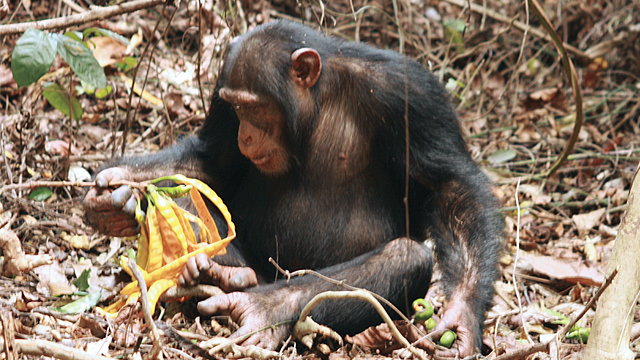
THEEZ LOOK LELISHUSS, HIC!: A chimpanzee feeding on the ripe fruits of Parkia bicolorHENRY GBEREGBE

Why are humans so attracted to alcohol, and why do so many struggle with its abuse? These are questions that science still can’t answer. The “drunken monkey” hypothesis proposed by University of California, Berkeley, biologist Robert Dudley posits that, unlike our attraction to other addictive drugs, our use and sometimes dependence on alcohol stems from the millions of years our ancient primate ancestors spent consuming ripe, fermented fruits. Perhaps these predecessors evolved some kind of neurological mechanism that drove them to seek out and consume sugar-rich, ethanol-containing foods, which were likely in short supply millions of years ago. But now that there’s a liquor store on every other corner, that drive to seek out alcohol has turned against us. (See “Drunks and Monkeys,” The Scientist, ...

Interested in reading more?

Become a Member of

The Scientist Logo
Receive full access to digital editions of The Scientist, as well as TS Digest, feature stories, more than 35 years of archives, and much more!
Already a member? Login Here

Related Topics

Meet the Author

  • Jef (an unusual nickname for Jennifer) got her master’s degree from Indiana University in April 2009 studying the mating behavior of seahorses. After four years of diving off the Gulf Coast of Tampa and performing behavioral experiments at the Tennessee Aquarium in Chattanooga, she left research to pursue a career in science writing. As The Scientist's managing editor, Jef edited features and oversaw the production of the TS Digest and quarterly print magazine. In 2022, her feature on uterus transplantation earned first place in the trade category of the Awards for Excellence in Health Care Journalism. She is a member of the National Association of Science Writers.

    View Full Profile

Published In

Share
Image of a woman with her hands across her stomach. She has a look of discomfort on her face. There is a blown up image of her stomach next to her and it has colorful butterflies and gut bacteria all swarming within the gut.
November 2025, Issue 1

Why Do We Feel Butterflies in the Stomach?

These fluttering sensations are the brain’s reaction to certain emotions, which can be amplified or soothed by the gut’s own “bugs".

View this Issue
Olga Anczukow and Ryan Englander discuss how transcriptome splicing affects immune system function in lung cancer.

Long-Read RNA Sequencing Reveals a Regulatory Role for Splicing in Immunotherapy Responses

Pacific Biosciences logo
Research Roundtable: The Evolving World of Spatial Biology

Research Roundtable: The Evolving World of Spatial Biology

Conceptual cartoon image of gene editing technology

Exploring the State of the Art in Gene Editing Techniques

Bio-Rad
Conceptual image of a doctor holding a brain puzzle, representing Alzheimer's disease diagnosis.

Simplifying Early Alzheimer’s Disease Diagnosis with Blood Testing

fujirebio logo

Products

Labvantage Logo

LabVantage Solutions Awarded $22.3 Million U.S Customs and Border Protection Contract to Deliver Next-Generation Forensic LIMS

The Scientist Placeholder Image

Evosep Unveils Open Innovation Initiative to Expand Standardization in Proteomics

OGT logo

OGT expands MRD detection capabilities with new SureSeq Myeloid MRD Plus NGS Panel










