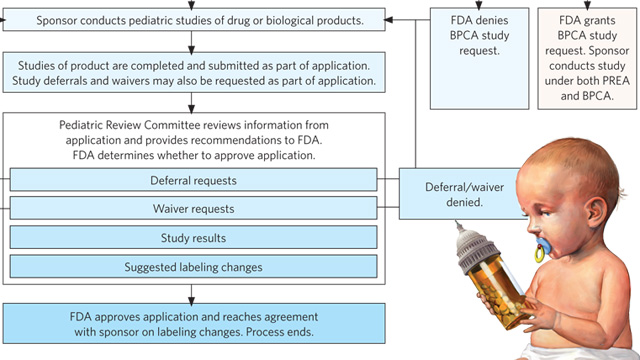
How the Pediatric Laws Work

The Pediatric Research Equity Act (PREA) of 2003 requires that companies developing new drugs that could be used to treat a condition in children perform clinical trials in kids before winning FDA approval.

Written byBob Grant
| 1 min read

Register for free to listen to this article
Listen with Speechify
0:00
1:00
Share

Infographic: How the Laws Work
View full size JPG | PDF
MATT COLLINS (BABY); US GOVERNMENT ACCOUNTABILITY OFFICE REPORT, "PEDIATRIC RESEARCH," MAY 2011

The Pediatric Research Equity Act (PREA) of 2003 requires that companies developing new drugs that could be used to treat a condition in children perform clinical trials in kids before winning FDA approval. The Best Pharmaceuticals for Children Act (BPCA) of 2002 offers financial incentives for companies to test drugs, either pre- or post-approval, in pediatric trials deemed necessary by the FDA.

Read the full story.

Interested in reading more?

Become a Member of

The Scientist Logo
Receive full access to digital editions of The Scientist, as well as TS Digest, feature stories, more than 35 years of archives, and much more!
Already a member? Login Here

Related Topics

Meet the Author

  • From 2017 to 2022, Bob Grant was Editor in Chief of The Scientist, where he started in 2007 as a Staff Writer. Before joining the team, he worked as a reporter at Audubon and earned a master’s degree in science journalism from New York University. In his previous life, he pursued a career in science, getting a bachelor’s degree in wildlife biology from Montana State University and a master’s degree in marine biology from the College of Charleston in South Carolina. Bob edited Reading Frames and other sections of the magazine.

    View Full Profile

Published In

Share
Image of a woman with her hands across her stomach. She has a look of discomfort on her face. There is a blown up image of her stomach next to her and it has colorful butterflies and gut bacteria all swarming within the gut.
November 2025, Issue 1

Why Do We Feel Butterflies in the Stomach?

These fluttering sensations are the brain’s reaction to certain emotions, which can be amplified or soothed by the gut’s own “bugs".

View this Issue
Olga Anczukow and Ryan Englander discuss how transcriptome splicing affects immune system function in lung cancer.

Long-Read RNA Sequencing Reveals a Regulatory Role for Splicing in Immunotherapy Responses

Pacific Biosciences logo
Research Roundtable: The Evolving World of Spatial Biology

Research Roundtable: The Evolving World of Spatial Biology

Conceptual cartoon image of gene editing technology

Exploring the State of the Art in Gene Editing Techniques

Bio-Rad
Conceptual image of a doctor holding a brain puzzle, representing Alzheimer's disease diagnosis.

Simplifying Early Alzheimer’s Disease Diagnosis with Blood Testing

fujirebio logo

Products

Labvantage Logo

LabVantage Solutions Awarded $22.3 Million U.S Customs and Border Protection Contract to Deliver Next-Generation Forensic LIMS

The Scientist Placeholder Image

Evosep Unveils Open Innovation Initiative to Expand Standardization in Proteomics

OGT logo

OGT expands MRD detection capabilities with new SureSeq Myeloid MRD Plus NGS Panel










