Image of the Day: Puzzle Plants

The jigsaw-shape cells found in the epidermis of many plants may serve to reduce mechanical stress on cell walls.

Written byThe Scientist and The Scientist Staff
| 1 min read

Register for free to listen to this article
Listen with Speechify
0:00
1:00
Share

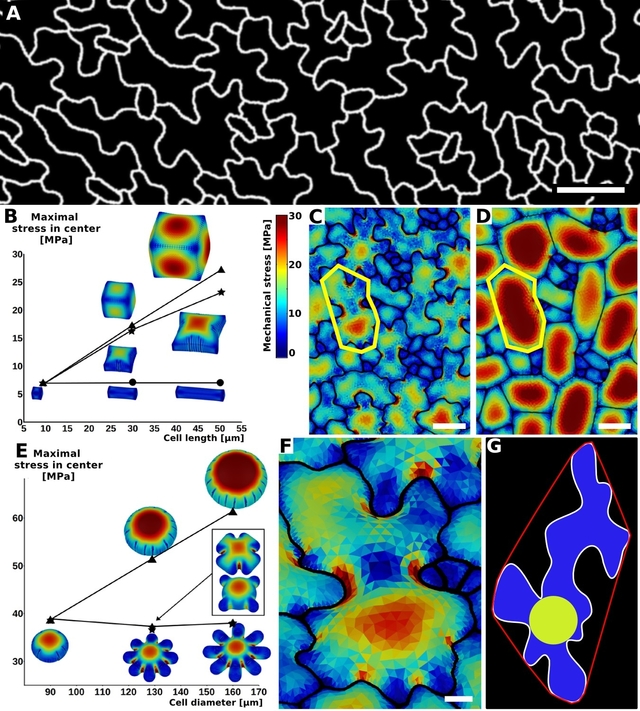
Relationship between cell shape and stress: (A) Cell contours in leaf cells of an Arabidopsis thaliana cotyledon. (B-F) Cellular stress patterns in computer simulations. (G) Measures used to quantify puzzle-cell shape and stressA. SAPALA ET AL.

Scientists have long puzzled over the erratically contoured cells in the outer layers of plants. According to a study published last month in eLife, the complex shapes may emerge to prevent cells from bulging under the internal stress produced by turgor pressure.

Researchers simulated plant cell growth with computer models and found that “paving” leaf surfaces with curvy cells, rather than smooth ones, reduces the stress on epidermal cell walls. They also found that complex puzzle-shape cells develop in parts of the plant that grow isotropically—uniformly in all directions—such as in leaves. In organs that grow directionally, such as roots or stems, cells that are long and thin can reduce stress on the cell walls.

A. Sapala et al., “Why plants make puzzle cells, and ...

Interested in reading more?

Become a Member of

The Scientist Logo
Receive full access to more than 35 years of archives, as well as TS Digest, digital editions of The Scientist, feature stories, and much more!
Already a member? Login Here
Image of a woman with her hands across her stomach. She has a look of discomfort on her face. There is a blown up image of her stomach next to her and it has colorful butterflies and gut bacteria all swarming within the gut.
November 2025, Issue 1

Why Do We Feel Butterflies in the Stomach?

These fluttering sensations are the brain’s reaction to certain emotions, which can be amplified or soothed by the gut’s own “bugs".

View this Issue
Golden geometric pattern on a blue background, symbolizing the precision, consistency, and technique essential to effective pipetting.

Best Practices for Precise Pipetting

Integra Logo
Olga Anczukow and Ryan Englander discuss how transcriptome splicing affects immune system function in lung cancer.

Long-Read RNA Sequencing Reveals a Regulatory Role for Splicing in Immunotherapy Responses

Pacific Biosciences logo
Research Roundtable: The Evolving World of Spatial Biology

Research Roundtable: The Evolving World of Spatial Biology

Conceptual cartoon image of gene editing technology

Exploring the State of the Art in Gene Editing Techniques

Bio-Rad

Products

Labvantage Logo

LabVantage Solutions Awarded $22.3 Million U.S Customs and Border Protection Contract to Deliver Next-Generation Forensic LIMS

The Scientist Placeholder Image

Evosep Unveils Open Innovation Initiative to Expand Standardization in Proteomics

OGT logo

OGT expands MRD detection capabilities with new SureSeq Myeloid MRD Plus NGS Panel










