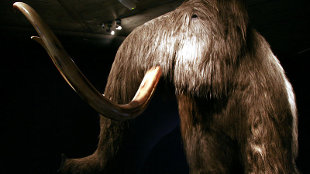
Modern Day Mammoth?

Researchers at Japanese and Russian institutions believe cloning a woolly mammoth is within reach.

Written byTia Ghose
| 1 min read

Register for free to listen to this article
Listen with Speechify
0:00
1:00
Share

MammothWIKIMEDIA COMMONS, RAMA

In the past few years, global warming has melted large swaths of Siberian permafrost, revealing several preserved mammoths, which went extinct about 10,000 years ago. Now, teams from the Sakha Republic mammoth museum and Kinki University in Japan plan to extract DNA from the marrow of one recently discovered mammoth and use it to clone the ancient beast, AFP reported.

The chosen mammoth was unearthed this past August in Siberia. The researchers say that its thigh bone is in good condition, and should yield DNA-containing marrow, which they can insert into an elephant egg, then grow the ice age creature inside of an elephant, which is a close relative of the mammoth. To succeed, the scientists must find and use DNA that has not been ...

Interested in reading more?

Become a Member of

The Scientist Logo
Receive full access to more than 35 years of archives, as well as TS Digest, digital editions of The Scientist, feature stories, and much more!
Already a member? Login Here

Related Topics

Meet the Author

Share
Image of a woman with her hands across her stomach. She has a look of discomfort on her face. There is a blown up image of her stomach next to her and it has colorful butterflies and gut bacteria all swarming within the gut.
November 2025, Issue 1

Why Do We Feel Butterflies in the Stomach?

These fluttering sensations are the brain’s reaction to certain emotions, which can be amplified or soothed by the gut’s own “bugs".

View this Issue
An image of a DNA sequencing spectrum with a radial blur filter applied.

A Comprehensive Guide to Next-Generation Sequencing

Integra Logo
Golden geometric pattern on a blue background, symbolizing the precision, consistency, and technique essential to effective pipetting.

Best Practices for Precise Pipetting

Integra Logo
Olga Anczukow and Ryan Englander discuss how transcriptome splicing affects immune system function in lung cancer.

Long-Read RNA Sequencing Reveals a Regulatory Role for Splicing in Immunotherapy Responses

Pacific Biosciences logo
Research Roundtable: The Evolving World of Spatial Biology

Research Roundtable: The Evolving World of Spatial Biology

Products

Labvantage Logo

LabVantage Solutions Awarded $22.3 Million U.S Customs and Border Protection Contract to Deliver Next-Generation Forensic LIMS

The Scientist Placeholder Image

Evosep Unveils Open Innovation Initiative to Expand Standardization in Proteomics

OGT logo

OGT expands MRD detection capabilities with new SureSeq Myeloid MRD Plus NGS Panel