Plastic Pollutants Pervade Water and Land

Contamination of marine and terrestrial ecosystems by microplastics is putting individual organisms at risk.

Written byEe Ling Ng
| 13 min read

Register for free to listen to this article
Listen with Speechify
0:00
13:00
Share

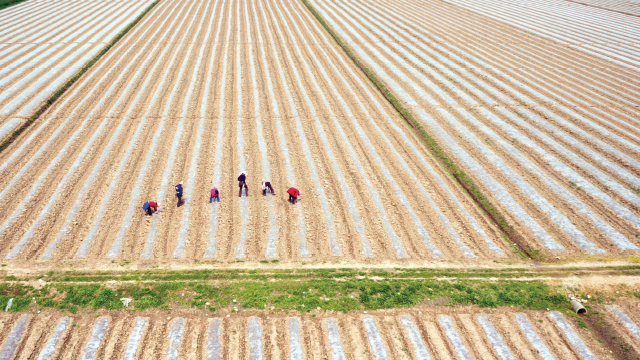
WHITE MULCH: Aerial view of farm land using plastic soil cover. Hubei province, central China.© JIE ZHAO/GETTY IMAGES

White stripes, each about a meter wide, painted the land for as far as the eye could see. I was visiting the dry areas of the autonomous Ningxia region in northwest China with colleagues from the Chinese Academy of Agricultural Sciences and the nonprofit Centre for Agriculture and Biosciences International. Those strips of plastic sheeting, I was told, allow farmers to grow cash crops and grains despite the desert-like conditions. The sheets, usually composed of polyethylene, help conserve water, suppress weeds, and boost soil temperatures, effectively increasing crop yields by 20 to 60 percent.

The use of plastic “mulch” to grow crops, known as the White Revolution, began in China in the late 1970s, and now covers 20 million hectares of the country’s agricultural land, ...

Interested in reading more?

Become a Member of

The Scientist Logo
Receive full access to digital editions of The Scientist, as well as TS Digest, feature stories, more than 35 years of archives, and much more!
Already a member? Login Here

Related Topics

Meet the Author

Published In

June 2017

Foregoing Food

The physiological effects of fasting

Share
Illustration of a developing fetus surrounded by a clear fluid with a subtle yellow tinge, representing amniotic fluid.
January 2026, Issue 1

What Is the Amniotic Fluid Composed of?

The liquid world of fetal development provides a rich source of nutrition and protection tailored to meet the needs of the growing fetus.

View this Issue
Skip the Wait for Protein Stability Data with Aunty

Skip the Wait for Protein Stability Data with Aunty

Unchained Labs
Graphic of three DNA helices in various colors

An Automated DNA-to-Data Framework for Production-Scale Sequencing

illumina
Exploring Cellular Organization with Spatial Proteomics

Exploring Cellular Organization with Spatial Proteomics

Abstract illustration of spheres with multiple layers, representing endoderm, ectoderm, and mesoderm derived organoids

Organoid Origins and How to Grow Them

Thermo Fisher Logo

Products

Brandtech Logo

BRANDTECH Scientific Introduces the Transferpette® pro Micropipette: A New Twist on Comfort and Control

Biotium Logo

Biotium Launches GlycoLiner™ Cell Surface Glycoprotein Labeling Kits for Rapid and Selective Cell Surface Imaging

Colorful abstract spiral dot pattern on a black background

Thermo Scientific X and S Series General Purpose Centrifuges

Thermo Fisher Logo
Abstract background with red and blue laser lights

VANTAstar Flexible microplate reader with simplified workflows

BMG LABTECH










