Questioning the HIV Cure

Sensitive tests reveal the Berlin patient believed to be cured of HIV still carries HIV RNA and antibodies.

Written byHayley Dunning
| 2 min read

Register for free to listen to this article
Listen with Speechify
0:00
2:00
Share

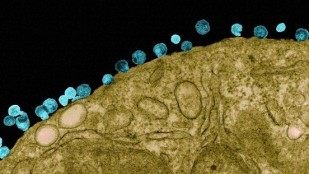
HIV viruses break away from a lymphocyte.THE CELL, WELLCOME IMAGES

Five years ago, Timothy Brown received transplants of bone marrow in Berlin to treat his leukemia. Because he also happened to be HIV-positive, he doctor chose a donor that carried a mutation in the CCR5 gene, which encodes a co-receptor that HIV uses to infect cells. Following his surgeries, Brown was able to stop conventional antiretroviral treatment and was deemed cured in 2009 when the virus failed to return. But research presented at the International Workshop on HIV & Hepatitis Virus last week (June 8) found HIV signals still lingering in Brown’s blood plasma, sparking well-known HIV researcher Alain Lafeuillade to suggest he has been re-infected, or was never cured.

Several labs looked at Brown’s blood, and some, but not all, found evidence of circulating ...

Interested in reading more?

Become a Member of

The Scientist Logo
Receive full access to more than 35 years of archives, as well as TS Digest, digital editions of The Scientist, feature stories, and much more!
Already a member? Login Here

Related Topics

Meet the Author

Share
Illustration of a developing fetus surrounded by a clear fluid with a subtle yellow tinge, representing amniotic fluid.
January 2026, Issue 1

What Is the Amniotic Fluid Composed of?

The liquid world of fetal development provides a rich source of nutrition and protection tailored to meet the needs of the growing fetus.

View this Issue
Skip the Wait for Protein Stability Data with Aunty

Skip the Wait for Protein Stability Data with Aunty

Unchained Labs
Graphic of three DNA helices in various colors

An Automated DNA-to-Data Framework for Production-Scale Sequencing

illumina
Exploring Cellular Organization with Spatial Proteomics

Exploring Cellular Organization with Spatial Proteomics

Abstract illustration of spheres with multiple layers, representing endoderm, ectoderm, and mesoderm derived organoids

Organoid Origins and How to Grow Them

Thermo Fisher Logo

Products

Brandtech Logo

BRANDTECH Scientific Introduces the Transferpette® pro Micropipette: A New Twist on Comfort and Control

Biotium Logo

Biotium Launches GlycoLiner™ Cell Surface Glycoprotein Labeling Kits for Rapid and Selective Cell Surface Imaging

Colorful abstract spiral dot pattern on a black background

Thermo Scientific X and S Series General Purpose Centrifuges

Thermo Fisher Logo
Abstract background with red and blue laser lights

VANTAstar Flexible microplate reader with simplified workflows

BMG LABTECH