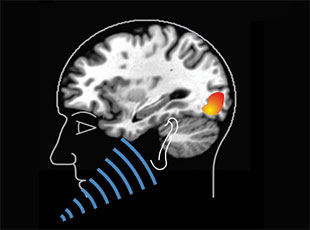
Sound and Light Show

Sounds trigger a response in the visual cortex that predicts how accurately a person can identify a visual target.

Written byTracy Vence
| 2 min read

Register for free to listen to this article
Listen with Speechify
0:00
2:00
Share

SOUND AND VISION: A noise activates the visual cortex (colored spot), which helps a viewer identify an object at the sound’s source. WENFENG FENG

The paper W. Feng et al., “Sounds activate visual cortex and improve visual discrimination,” J Neurosci, 34:9817-24, 2014. The context Noticeable sounds activate neurons in the visual cortex, helping us make out visual targets at the location the sounds came from. Wenfeng Feng of SooChow University in China and colleagues last year observed neural correlates of such sensory tag-teaming in human brain recordings: an activation in the visual cortex of the brain hemisphere opposite the source of the sound, called the auditory-evoked contralateral occipital positivity (ACOP). The experiment To figure out how ACOP functions, Feng’s group used electroencephalography (EEG) to study the performance of 16 volunteers. Each participant heard a noise from a speaker on the left or right side of a monitor, after which ...

Interested in reading more?

Become a Member of

The Scientist Logo
Receive full access to digital editions of The Scientist, as well as TS Digest, feature stories, more than 35 years of archives, and much more!
Already a member? Login Here
Illustration of a developing fetus surrounded by a clear fluid with a subtle yellow tinge, representing amniotic fluid.
January 2026, Issue 1

What Is the Amniotic Fluid Composed of?

The liquid world of fetal development provides a rich source of nutrition and protection tailored to meet the needs of the growing fetus.

View this Issue
Skip the Wait for Protein Stability Data with Aunty

Skip the Wait for Protein Stability Data with Aunty

Unchained Labs
Graphic of three DNA helices in various colors

An Automated DNA-to-Data Framework for Production-Scale Sequencing

illumina
Exploring Cellular Organization with Spatial Proteomics

Exploring Cellular Organization with Spatial Proteomics

Abstract illustration of spheres with multiple layers, representing endoderm, ectoderm, and mesoderm derived organoids

Organoid Origins and How to Grow Them

Thermo Fisher Logo

Products

Brandtech Logo

BRANDTECH Scientific Introduces the Transferpette® pro Micropipette: A New Twist on Comfort and Control

Biotium Logo

Biotium Launches GlycoLiner™ Cell Surface Glycoprotein Labeling Kits for Rapid and Selective Cell Surface Imaging

Colorful abstract spiral dot pattern on a black background

Thermo Scientific X and S Series General Purpose Centrifuges

Thermo Fisher Logo
Abstract background with red and blue laser lights

VANTAstar Flexible microplate reader with simplified workflows

BMG LABTECH